Cordless Pool Robot for Above-Ground Pools: Worth It?
This cordless pool robot pulled fine debris, leaves, and sand-like dirt from my above-ground pool. It is simple, practical, and built for flat floors—not perfect coverage.
Affiliate disclosure: As an Amazon Associate I earn from qualifying purchases. This article may contain affiliate links, which means I may earn a commission at no extra cost to you.
If you are shopping for a cordless pool robot for above-ground pools, the main question is not whether it looks like a robot. It is whether its cleaning style matches your pool floor. This one is a straightforward cordless floor cleaner: I charged it, filled it with water before release, let it roam for about two hours, retrieved it at the sidewall, and found fine debris, leaves, and brown sand-like material inside.
That makes it useful for routine debris maintenance in a genuinely flat above-ground pool. It is not a mapped cleaner that works through a planned route, and it is not a cure for established algae. In my pool, those distinctions were easy to see: it changed direction after reaching a wall, wandered in a zigzag pattern, and diverted at a crease where the ground beneath my liner had settled unevenly.
A solid cordless floor-cleaning option for flat above-ground pools. It picked up fine debris, leaves, and sand-like dirt well in my run, but its random path and passive wheels make it a poor match for uneven floors, slopes, or algae cleanup.
As an Amazon Associate I earn from qualifying purchases.
| Best for | Flat-bottom above-ground pools |
|---|---|
| Cleaning style | Cordless random-roaming floor cleaning |
| Observed runtime | About 2 hours |
| Charging time | About 2–3 hours |
| Retrieval | Pool-pole hook with quick-release drain |
| Debris handled | Fine debris, leaves, sand-like dirt |
Who should buy this cordless pool robot for above-ground pools?
I think this cleaner makes the most sense for an above-ground pool owner who wants an easy way to collect the ordinary debris that settles on the floor between more complete pool-care tasks. Leaves, dead bugs, grass, dirt, fine material, and sandy debris are the kind of mess I would have in mind. The appeal is not advanced navigation. It is putting a cordless cleaner in the water, letting it work through a battery-limited cycle, then emptying what it collected.
A flat floor is the non-negotiable part of that recommendation. This robot uses propulsion with passive wheels rather than a deliberate, mapped travel pattern. When it reached a pool wall in my run, it changed direction and headed away again. In open, level space, that roaming behavior can be a perfectly reasonable way to maintain a pool floor. It is less appealing if you need predictable passes over every area during every cycle.
It can also be used in an in-ground pool only if the entire bottom is flat. I would not treat “in-ground compatible” as meaning it suits a typical shallow-end-to-deep-end pool. A depth transition or slope is not the environment this design is intended to handle. The same caution applies to an above-ground pool with a pronounced liner crease or a settled area below it.
This is also a good fit for someone comfortable with a small, repeatable maintenance routine. I charged it through the port on the underside, started it with one button, retrieved it with the included hook on a pool pole, rinsed the screen and collection area, and dried the charging port before charging again. There is no cable to manage around the deck and no hose to prime. That simplicity is a meaningful advantage if you want a floor-debris tool rather than another complicated piece of pool equipment.
I would look elsewhere if wall cleaning, waterline cleaning, precision coverage, or algae removal is the priority. I used this as a floor cleaner. It does contact the sidewall as part of changing direction and parking for retrieval, but I would not buy it expecting it to climb and clean walls. Likewise, it is meant to collect debris before it becomes part of a bigger maintenance issue, not to remove visible green growth that needs chemistry and brushing attention.
My setup and first cleaning run
The initial setup was simple, but there is one detail worth taking seriously. Charging happens at a port on the bottom of the unit, and I found the charge time to be about two to three hours. Once it was charged, the one-button control illuminated with a pinkish-purple status light.
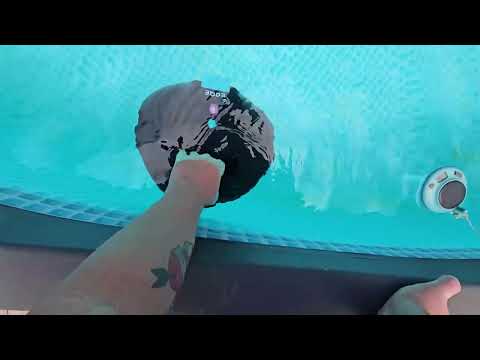
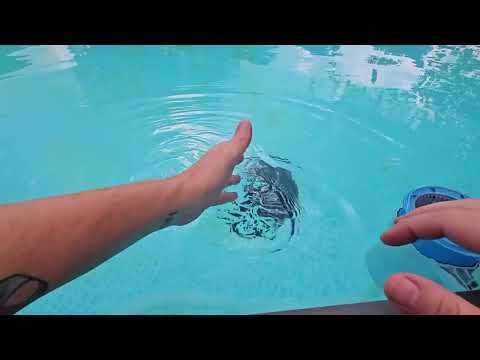
Before I released it, I fully submerged the cleaner and let it fill with water. I did not simply set it on the surface and hope it would settle properly. Filling it first kept it from flipping over and gave it the start it needed. That is a normal part of the routine with this cleaner, so buyers should factor it in rather than expecting a toss-it-in-and-walk-away experience.
The hardware is uncomplicated. There are two debris intake openings with passive brush-like pieces nearby. The wheels are passive too. Instead of steering itself through a stored map, the cleaner relies on propulsion and an internal flap or rudder arrangement. When it encounters a wall, it can change the direction of its propulsion and move off in another direction.
Watching it operate made the design philosophy clear. It was not tracing neat lines across the floor. It moved in an unsystematic zigzag, reached a wall, redirected, and continued roaming. I think “tiny jet ski” is a fair mental picture: it is propulsion-based and travels where its wall contacts and position send it, rather than deciding that a particular section still needs a pass.
That does not make it ineffective. It changes what “effective” means. If it runs over debris, the pickup was strong in my first run. But a random-roaming cleaner is always a compromise for buyers who are concerned about exact coverage. The two-hour cycle gives it a decent amount of time in the pool, yet runtime and guaranteed floor coverage are different things.
Debris pickup was the real strength
After roughly two hours, the cleaner finished close to the sidewall. That is where it is designed to park when the battery reaches roughly 15%, and it did so in my use. I attached the hook to a pool pole, pulled the unit up, and used the quick-release opening to drain water back into the pool before carrying it away. That drain is a practical feature. A water-filled cleaner is awkward and heavier than it needs to be, so getting some of that water out before removal makes the routine easier.
Inside, I found exactly the mix that makes a cordless floor cleaner worthwhile: fine material on the screen, leaves, and a surprising amount of brown, sandy-looking debris in the larger collection area. The pool did not appear to have much debris before the run, which made the material it did collect more noticeable. For the debris it actually traveled over, I thought it did a great job.
The collection system has two useful jobs. The screen catches smaller material, while the larger interior compartment holds bigger debris. This is especially helpful for sand and dirt. I like this style of larger collection area because it captured material that I do not always expect filter-style pool vacuums to handle as well. For normal floor junk, that combination is one of the cleaner’s best arguments.
There is still a limit: debris smaller than the holes in the screen can pass back into the pool. That does not erase the good pickup I saw, but it means this is not a replacement for every part of a pool’s filtration and maintenance system. It is a practical collector for the debris sizes it can retain.
It is also important not to confuse debris pickup with algae cleanup. I had green spots in the pool, and this cleaner was not made to remove established algae. Its better role is collecting leaves, dirt, bugs, and other material before that debris has time to contribute to pool problems. If algae is already present, address the water and brushing work first rather than expecting a floor robot to solve it.
Flat floors matter more than the marketing language
The biggest real-world limitation I found was at a crease in my pool floor. The ground beneath that part of the liner had settled unevenly, creating a noticeable raised or folded area. When the robot reached it, it diverted rather than crossing it. With passive wheels and propulsion-based movement, that response was not surprising, but it is exactly why I would take the flat-bottom recommendation literally.
A pool can look broadly flat and still have trouble spots. If your liner has creases, the base has settled, or the floor has an uneven patch, this cleaner may treat that area as an obstacle. It may clean around it over time, but I would not count on it to cross every imperfection reliably. Buyers with a smooth, level floor should get the best fit from this design.
The random path is the other tradeoff. A mapped robot can be preferable when you want confidence that it will work methodically through the available floor. This cleaner does not make that promise. It bounces off the sidewall, changes direction, and roams. For regular maintenance in a flat above-ground pool, I am comfortable with that simpler approach. For a pool where debris constantly gathers in one hard-to-reach section, or where each cleaning cycle needs to be predictably thorough, I would choose a more deliberate system.
The cycle and recharge rhythm also matters. I got approximately two hours of cleaning time, which I consider long for this style of cordless pool vacuum; I noted that many comparable styles are closer to 90 minutes. Afterward, I needed roughly two to three hours to charge it again. The current listing states a 120-minute runtime, along with dual-motor suction, dual-layer filtration, and smart self-parking. My firsthand use supports the approximately two-hour run and sidewall-parking behavior, but I did not assess long-term battery durability or repeated-cycle consistency.
+ Pros
- Collected fine debris, leaves, and brown sand-like material in my first run
- About two hours of cleaning time is strong for this style of cordless cleaner
- Large collection area handled sand and dirt well
- Four latches felt secure and confidence-inspiring
- Quick-release drain reduces the weight before removal
- Parked near the sidewall for easy hook retrieval
− Cons
- Roams in a random zigzag pattern rather than following a mapped route
- Can divert around creases or uneven areas in the pool floor
- Very fine debris smaller than the screen holes can pass through
- Not intended to remove established algae
Cleanup and recharge are easy to live with
Maintenance after a run is not difficult. The debris compartment opens with four latches, then the internal screen and collection section lift out. I particularly liked having four latches. Some above-ground pool cleaners use fewer clamps, and I do not always feel sure those are seated correctly. Here, the closure felt more secure and confidence-inspiring when I latched it back up.
The internal screen is keyed, so it fits back into the cleaner only one way. That is a small but welcome design choice because it removes the guesswork at reassembly. I did not have to puzzle over its orientation or force it into place.
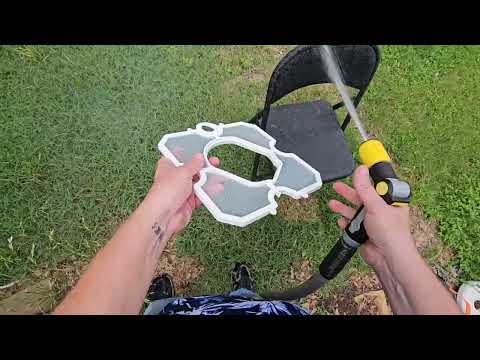
I rinsed the debris container and the screen with a hose. My useful maintenance tip is to rinse the screen from the outside first. That helps push captured debris out rather than pushing it farther into the screen. After that, rinse the opposite side and check that the larger collection area is clear. Leftover debris is not something I want sitting in the cleaner between runs.
Before plugging it in again, dry the underside charging port. It takes only a moment, and it is the sensible final step after using and rinsing a rechargeable pool cleaner. The ongoing routine is therefore straightforward: retrieve it, drain it, unlatch it, rinse the container and screen, reassemble it, dry the port, and recharge when needed.
Buyer questions before choosing this pool cleaner
How large a pool can it cover? I did not establish an exact pool-size coverage limit. Its two-hour cycle and roaming pattern may be enough for routine debris control in one flat pool while being less satisfying in another. I would focus less on an assumed square-footage claim and more on whether your pool floor is genuinely flat and whether you can accept non-mapped travel.
Does sidewall parking make retrieval automatic? It makes retrieval easier, not hands-free. The cleaner parked close to the sidewall at the end of my run, and I used the included hook on a pool pole to pull it out. The quick-release drain then reduced the amount of water I had to lift away.
Is this an all-day cleaner? No. It is designed around a battery-limited cleaning cycle of about two hours, followed by roughly two to three hours of charging in my use. I see it as a grab-and-go maintenance tool for periodic runs, not equipment that stays active in the pool continuously.
Will it handle a heavy leaf load? I found leaves, fine debris, and sandy-looking dirt after my run, but I did not test severe debris conditions or a heavy leaf load. The larger collection area is helpful for the debris I encountered, but I cannot say how frequently it would need emptying in a pool covered with leaves.
Specs
| Spec | Detail |
|---|---|
| Product type | Cordless rechargeable robotic pool cleaner |
| Recommended pool surface | Flat-bottom above-ground pools |
| In-ground compatibility | Flat-bottom pools only; no depth changes |
| Observed cleaning cycle | Approximately 2 hours |
| Observed charge time | Approximately 2–3 hours |
| Intake design | Two debris intake openings with passive brush-like pieces |
| Navigation | Propulsion-based random roaming with wall-contact direction changes |
| Debris access | Four-latch compartment with removable keyed screen |
| Retrieval method | Hook on a pool pole |
| Listing-stated features | Dual-motor suction, dual-layer filtration, smart self-parking, 120-minute runtime |
Scorecard
Collected fine debris, leaves, and sand-like material.
One-button start and a simple cleanup routine.
About two hours is strong for this cleaner type.
Random zigzag travel is practical, not mapped.
Floor creases and uneven spots can redirect it.
The removable screen and container rinse out quickly.
Final recommendation
I would recommend this cordless pool robot for above-ground pools when the floor is flat and the goal is uncomplicated debris maintenance. It was easy to charge and start, it ran for about two hours, it parked where I could retrieve it, and it collected fine debris, leaves, and brown sand-like dirt. The roomy collection area, four-latch compartment, keyed screen, and quick-release drain all made the ownership routine more practical.
Buy it with the right expectations. It is not a smart mapped robot, it can divert around floor creases, and it is not designed to solve an algae problem. But if your pool is level and you want a cordless cleaner that can roam the floor and remove the material it encounters, it is a capable, simple option.
As an Amazon Associate I earn from qualifying purchases.
Frequently asked questions
Does this cordless pool robot clean pool walls?
I used it as a floor cleaner in an above-ground pool. I would not buy it expecting wall or waterline cleaning.
Will it work in an in-ground pool?
Only if the in-ground pool has a completely flat bottom with no shallow-to-deep transition or slope.
How long does the cleaning cycle last?
My run lasted about two hours. I charged it through the underside port, and charging took about two to three hours in my use.
Does it pick up sand and fine debris?
Yes. I found brown sand-like material, leaves, and fine debris after the run. Material smaller than the screen holes can pass back into the water.
How do you get it out of the pool?
Use the included hook on a pool pole. Once it is near the sidewall, lift it to the surface and use the quick-release drain to let water empty before carrying it away.