Wireless ANC Gaming Headphones: Worth It for Travel Too?
FIFINE’s wireless ANC over-ear headphones combine a comfortable fit, gaming-mode controls, transparency mode, and wired USB-C flexibility.
Affiliate disclosure: As an Amazon Associate I earn from qualifying purchases. This article may contain affiliate links, which means I may earn a commission at no extra cost to you.
The FIFINE Wireless ANC Over-Ear Headphones are wireless ANC gaming headphones with a wider job in mind than sitting at a desk. I found the cushions soft, the ear openings comfortable for my ears, and the adjustable headband and swiveling cups easy to work with.I confirmed the grid was energized while the unit was powered. Do not touch or probe the grid while it is connected to power. If you want one headset for games, music, calls, and travel rather than separate gear for each, that combination is the reason to consider it.
A flexible over-ear option for buyers who want soft cushions, ANC/transparency controls, a wired USB-C fallback, and a gaming-mode toggle in one headset. I liked the fit and feature set; just expect to learn the tap gestures.
As an Amazon Associate I earn from qualifying purchases.
My first impression is that FIFINE has built this around practical switching between situations. You can use noise control when you want less outside distraction, let outside sound in when awareness matters, connect by cable when that is more convenient, and enable a gaming-focused mode without hunting through an app. That does not answer every performance question—my hands-on source did not establish battery runtime, call quality, noise-cancellation strength, wireless range, or measured latency—but it does establish a clear set of controls and physical features.
| Type | Wireless over-ear ANC headphones |
|---|---|
| Noise control | ANC on, ANC off, and transparency mode |
| Gaming feature | Triple-tap gaming mode with audible feedback |
| Connection | USB-C charging and direct wired-device connection |
| Microphones | Built-in pickup plus external gaming-style mic input |
| Fit features | Soft cushions, expandable band, swiveling earcups |
Wireless ANC Gaming Headphones Need to Fit First
Before I worry about modes, ports, or a gaming label, I start with fit. Over-ear headphones need to get the basic physical experience right because soft features are not much help if the cups press on your ears or the band will not settle comfortably. These started well for me: the cushions felt very soft, and my ears fit inside the openings comfortably. That is a meaningful distinction with an over-ear design, since the intended fit is around the ear rather than against it.
The headband expands, and it accommodated my head without drama. The earcups also swivel in the directions I needed them to. Those may sound like standard headphone details, but they are the details that make it easier to position a headset instead of accepting a fixed angle. Between the expandable band, soft cushioning, and swivel, I could make ordinary fit adjustments without fighting the headset.
FIFINE marks the left and right sides clearly as well. That is a small usability point, but it eliminates needless guesswork when you pick the headphones up. It also helps you orient the control side quickly, since the main buttons are concentrated on the right earcup.
I did not wear these through a full workday, a long flight, or a marathon gaming session, so I cannot give a long-session comfort verdict. Nor can I say how this fit will translate to every head or ear shape. What I can say from using them is that the initial fit fundamentals were good: my ears had room, the pads were soft, the band adjusted for me, and the cups moved where I needed them to move.
That makes these a more interesting choice for buyers who do not want a rigid, desk-only gaming headset. A headset that can settle comfortably is more likely to get used for a music break, a call, or a trip as well as a game. The fit features do not guarantee all-day comfort, but they give the design a sensible starting point.


ANC and Transparency Make the Travel Angle Practical
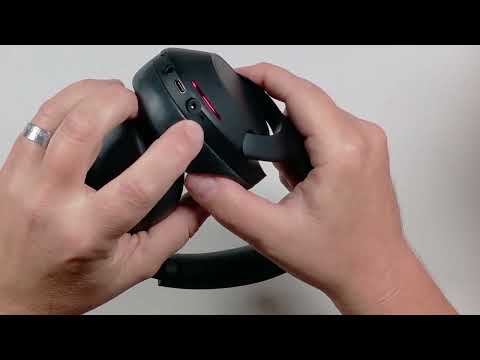
The most useful non-gaming feature here is the noise-control system. The right-side noise-control button cycles among ANC on, ANC off, and transparency mode. These are three distinct choices rather than a single on/off approach, which matters because you may not always want the same relationship with the room around you.
ANC on is the mode to select when you want the headphones to prioritize reduced outside distraction. ANC off is there when you simply do not want that processing engaged. Transparency mode takes the opposite direction: it is designed to let you hear more of what is happening around you while you keep listening. I see that as especially relevant for travel, where an announcement, a conversation, or a change in your surroundings can matter even when you do not want to stop your audio.
There is also a quicker temporary-transparency action. Holding your finger on the touch area activates transparency temporarily, and releasing it returns you to your regular sound. That is a thoughtful control concept for short interruptions. Instead of pausing, changing a full mode, talking, and then reversing the process, you can briefly check what is happening around you and move on.
The transcript uses examples such as hearing an announcement on a plane or hearing somebody speak during a run. The underlying buyer benefit is not limited to those examples. Temporary awareness can be useful whenever you need a moment of outside sound but do not want to remove the headphones. It is a more flexible arrangement than treating noise control as something you set once and forget.
I did not directly evaluate how much outside noise ANC removes, how the modes affect audio character, or how natural the transparency processing sounds. Those are important performance differences between headphone models, and I would not infer them simply from the availability of the modes. Still, I like the access design: there is a dedicated noise-control button for the three main states and a separate hold gesture for a quick awareness check.
Gaming Mode and Bass Controls Reward a Little Memory
Gaming features are present, but FIFINE handles them with touch gestures rather than dedicated labeled buttons. A double tap toggles bass on or off, and an audible tone confirms the change. A triple tap activates gaming mode, with a different audible confirmation. The feedback is valuable because a touch surface does not give you the same physical confirmation as a clicky switch.
Gaming mode is intended to change latency. That is the logical feature to include in wireless ANC gaming headphones, where audio timing can be more noticeable in games than during casual music listening. I appreciate that the mode is reachable directly on the headset. You do not have to open software or navigate a companion menu just to access it.
The trade-off is control recall. Double tap means bass; triple tap means gaming mode. It is not a difficult system, but it asks you to remember which repeated touch does what. The fact that most physical buttons live on the right side keeps the general layout straightforward, yet the touch extras still take a little familiarization. Audible tones reduce uncertainty after the gesture, but they do not remove the small learning curve before it becomes habit.
I did not measure latency or compare games with gaming mode on and off, so I cannot make a claim about its real-world latency result. I would treat it as a useful available option rather than a reason to buy solely on an assumed performance target. Buyers who need a specific verified latency level should seek testing that directly measures it. Buyers who want an easy-access gaming-mode toggle alongside broader everyday features have a more reasonable basis for interest here.
The bass gesture follows the same philosophy: it offers a quick adjustment without adding another visible button. Since I did not assess bass output with the setting on and off, I would not characterize the sound change itself. The supported takeaway is simpler: bass can be toggled from the headset, and the audible notification tells you the command registered.
USB-C Wired Use and Two Microphone Paths Add Options
One of the reasons I would not pigeonhole these as gaming-only headphones is the USB-C connection. It is used for charging, and the included cable can also connect the headphones directly to a device such as a laptop. That wired fallback is useful when wireless use is not your preference or when a direct connection better suits the device and situation in front of you.
Plane use is the obvious travel example mentioned in my source material. A cable option is helpful for someone who wants to pack one set of headphones and retain an alternative to wireless operation. The important wording here is alternative: I am not treating the wired connection as proof of compatibility with every device, seatback system, or USB-C implementation. It does mean the headphones are not limited to wireless use alone.
Microphone flexibility is another notable part of the physical layout. There is a built-in microphone pickup on the headset, and there is also a port for connecting an external gaming-style microphone. That gives the product two possible microphone approaches: the built-in pickup for straightforward convenience and an external-mic route for someone who wants to explore a more traditional gaming-style setup.
I did not assess built-in microphone clarity, call quality, in-game voice quality, or the quality of a connected external microphone. The exact external-microphone connector type and compatibility were not specified either. So this is not a claim that one option sounds better than the other. It is a practical versatility point: the headset includes a built-in pickup while also leaving room for an external gaming-style mic.
For shoppers comparing multipurpose wireless headphones with conventional gaming headsets, that distinction matters. A simple music headset may give you wireless playback but no external-mic path. A dedicated gaming headset may prioritize the mic but offer fewer travel-oriented listening controls. FIFINE is trying to bring those use cases together, and its wired USB-C option plus the two microphone paths explain why it feels broader than a basic wireless pair.
+ Pros
- Soft cushions and ear openings that fit my ears comfortably
- Expandable headband and swiveling earcups help with fit adjustment
- ANC, ANC off, and transparency mode provide useful listening choices
- USB-C wired connection offers an alternative to wireless use
- Built-in microphone pickup plus an external gaming-style microphone input
- Audible feedback helps identify bass and gaming-mode changes
! What to know
- Controls are concentrated on the right side.
- Bass and gaming mode use double- and triple-tap gestures, so there is a little control memory involved.
- Gaming mode is intended to change latency, but I did not measure its latency effect.
- I did not evaluate ANC strength, call quality, microphone clarity, battery runtime, or wireless range.
Who Will Get the Most From These FIFINE Headphones?
I would put these on a shortlist if your goal is one pair of wireless ANC gaming headphones for several parts of your routine. The soft over-ear cushions, adjustable structure, ANC choices, transparency access, gaming-mode control, and USB-C wired alternative all support that all-purpose role. The product makes particular sense if you would rather carry one adaptable headset than keep separate pairs for the desk, travel, and casual listening.
They also suit buyers who value control access over app dependence. Power, volume, and noise control are handled with physical controls, while bass and gaming mode are available from touch gestures. The setup is not completely button-based, but the important point is that the core changes are made on the headphones themselves. The confirmation tones are helpful when you are not looking at the earcup.
Travel-minded buyers have a straightforward reason to look: ANC and transparency are available, temporary transparency is quick to access, and the included USB-C cable supports direct connection to a compatible device. Someone who wants outside awareness available without removing their headphones may find the hold gesture more useful than expected.
I would be more cautious if your purchase decision depends on a measured ANC result, a verified wireless range, an established battery runtime, particular Bluetooth or codec support, specific external-mic compatibility, or a documented low-latency gaming number. Those answers were not established in the firsthand source I used. Likewise, I cannot say how the fit performs for other users or after many continuous hours. Those are not reasons to dismiss the product; they are reasons to match your expectations to what has actually been assessed.
Buying Decision: Feature Range Over Single-Purpose Focus
The core decision is whether you value range. FIFINE gives you an over-ear fit that worked well for me initially, three noise-control states, temporary transparency, bass and gaming gestures, a wired USB-C option, a built-in mic pickup, and an external gaming-mic input. That is a lot of functional territory for one pair of headphones.
The compromise is not a major defect so much as a usage preference. The touch gestures are less immediately obvious than separate hardware buttons. If you strongly prefer every control to be tactile and uniquely labeled, you may find double- and triple-tap actions less satisfying. If you can remember the two gestures, the audible tones give useful confirmation and the arrangement keeps the exterior relatively simple.
My recommendation is therefore aimed at the flexible buyer: someone who games but also listens to music, takes calls, travels, or exercises and wants features that can move between those activities. For that person, the mix is compelling. For someone shopping only for independently verified microphone performance, maximum noise reduction, or a proven competitive-gaming latency figure, more direct evidence on those specific priorities is needed before choosing.
Specs
| Spec | Detail |
|---|---|
| Headphone design | Over-ear cushioned earcups |
| Headband | Adjustable/expandable |
| Earcups | Swiveling design with left/right labels |
| Noise modes | ANC on, ANC off, transparency mode |
| Bass control | Double-tap bass on/off toggle |
| Gaming control | Triple-tap gaming mode |
| Temporary awareness mode | Touch-and-hold transparency access |
| Charging/wired connection | USB-C |
| Microphone options | Built-in microphone pickup and external gaming-style microphone input |
Scorecard
Soft cushions, roomy ear openings, adjustable band, and swivel helped.
Gaming, music, calls, travel, ANC, and wired use are all covered.
Three modes plus a temporary transparency shortcut are practical.
Audible tones help, but double- and triple-tap gestures take recall.
Gaming mode is easy to activate, though I did not measure its latency effect.
FAQ: FIFINE Wireless ANC Gaming Headphones
Do the FIFINE Wireless ANC Over-Ear Headphones have noise cancellation?
Yes. The noise-control button provides ANC on, ANC off, and transparency mode. There is also a touch-and-hold shortcut for temporary transparency, which lets you briefly hear more of your surroundings before returning to regular audio.
Can these headphones be used with a cable?
Yes. USB-C is used for charging, and the included cable can connect the headphones directly to a compatible device such as a laptop. This provides a wired alternative to wireless use. Compatibility with every USB-C device or travel system was not established.
Do they have a microphone for gaming or calls?
They have a built-in microphone pickup and an input for an external gaming-style microphone. I did not assess microphone sound quality, call quality, or the external microphone connector and compatibility, so those remain buyer questions.
How do you activate gaming mode?
A triple tap activates gaming mode, and an audible tone confirms the change. Gaming mode is intended to change latency. I did not measure its latency effect, so I cannot quantify the result in use.
Can you change the bass setting on the headphones?
Yes. A double tap toggles bass on or off, and the headphones provide an audible tone to confirm the command. I did not evaluate the resulting sound difference, but the control is available directly from the headset.
Are these comfortable over-ear headphones?
In my initial use, yes. I found the cushions very soft, my ears fit comfortably inside the openings, and the expandable headband and swiveling earcups helped me adjust the fit. I did not perform a long-session comfort assessment.
Final Take
The FIFINE Wireless ANC Over-Ear Headphones make the strongest case as a flexible headset rather than a one-note gaming accessory. I liked the initial comfort, the room for my ears, the adjustability, and the straightforward physical layout. ANC, transparency, temporary awareness access, wired USB-C use, and the gaming-mode gesture give the headset credible reasons to leave the desk.
The tap controls require a little memory, and there are important performance categories I did not evaluate. But if you want a soft, adjustable over-ear pair that can move among gaming, music, calls, travel, and general activity, this feature mix is worth a close look.
As an Amazon Associate I earn from qualifying purchases.