Cordless Leaf Blower: Is a Push Switch Better for You?
The RYAHT DD8179 is a lightweight 20V cordless leaf blower kit with two batteries, two speeds, and a push-up control that avoids trigger fatigue.
Affiliate disclosure: As an Amazon Associate I earn from qualifying purchases. This article may contain affiliate links, which means I may earn a commission at no extra cost to you.
The RYAHT DD8179 makes a straightforward case for a cordless leaf blower that is easy to pick up and use. In my hands, it felt super, super lightweight. It has a battery that mounts directly on the tool, a second battery and charger in the kit, two speed settings, and a push-up control instead of a trigger that must stay squeezed. For quick, routine cleanup, that control choice is the part that most separates it from many familiar cordless blower designs.
This is a compact 20V cordless leaf blower kit, not a machine I would automatically put in the heavy-duty-yard category. The appeal is less about chasing a long feature list and more about reducing the little points of friction that can keep a tool from being useful: holding a trigger, wondering whether the battery has charge, needing to wait on a sole battery, or finding room to store a long tube. The RYAHT handles those practical points in a notably simple way.
If you are shopping specifically because trigger-operated tools make your finger tired, this review is for you. I used the low and high settings, handled the battery, attached the directional nozzle, and detached the tube assembly. Those are the experiences that inform this review. I did not measure airflow, noise, runtime, charge time, or performance on demanding leaf piles, so those should remain separate buying questions.
A solid fit for routine small-area cleanup if you want a lightweight cordless leaf blower with a no-trigger control, two batteries, and simple two-speed operation.
As an Amazon Associate I earn from qualifying purchases.
| Power type | 20V cordless battery tool |
|---|---|
| Speed control | Two settings: low and high |
| Control style | Push-up on/off and speed switch |
| Battery kit | Two batteries and charger included |
| Nozzle options | Wide main tube plus clip-on directional nozzle |
| Storage | Removable tube/nozzle assembly |
Why the push switch changes this cordless leaf blower
Many cordless blowers use a squeeze trigger. A trigger can feel intuitive because output is tied directly to your finger, but there is a basic comfort tradeoff: your hand has to keep that trigger held while the blower is running. Even when a trigger is easy to pull, that sustained hold can get old over time. My preference here is the RYAHT’s push-up control because it lets the blower run without requiring a continuous finger squeeze.
The control has two available settings. I pushed it to low and then to high, with the tool remaining on at the selected setting. That makes the operation very easy to understand. Select low when you do not need the higher setting; select high when you do. There is no learning curve involving a variable trigger position or trying to maintain a particular amount of pressure.
That simplicity is both the product’s comfort advantage and its main control limitation. This is not a continuously variable blower. I could not feather the power to an in-between level through trigger pressure, because the choices are discrete: low and high. Buyers who like having an obvious choice between two modes may find that refreshingly uncomplicated. Buyers who routinely want precise, constantly changing output should recognize that this is a different control philosophy.
For my use, the no-trigger approach makes the tool feel well suited to brief cleanup sessions. Instead of thinking about a control finger, I could focus on holding the lightweight blower and aiming its tube. It is a small ergonomic detail, but it is one of those details that can matter every time a yard tool comes out of storage.
Lightweight handling is the first impression that matters
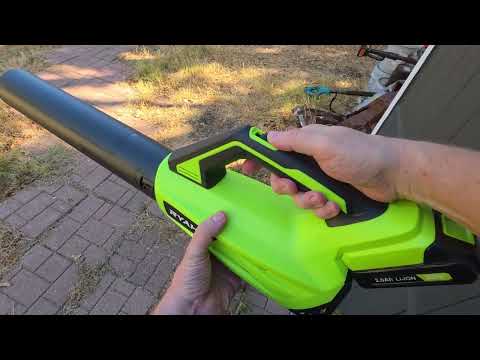
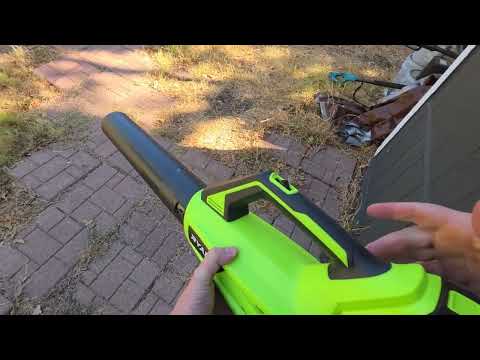
The first thing I noticed about this cordless leaf blower was its weight. It is super, super lightweight in hand. That is a firsthand feel rather than a measured comparison, but it is meaningful for the person deciding whether a blower seems approachable for regular use. A lighter-feeling tool is easier to imagine grabbing for a fast pass over a patio area, a walkway, a garage entrance, or another small outdoor space.
That does not mean lightweight automatically equals the strongest choice for every job. Weight and output are separate questions, and I did not establish airflow or air-speed measurements. What I can say is that the tool’s handling supports its simple, small-area-cleanup personality. It does not feel like an oversized machine that needs a major reason to be taken out.
The long main tube gives the blower a conventional reach, and its larger end supports a broader airflow approach. The body, battery placement, tube, and uncomplicated control all work together as a package that is easy to understand. For someone who wants a tool with fewer operating decisions, that can be more valuable than an elaborate set of settings.
It is also worth separating easy handling from claims about endurance. I did not use this cordless leaf blower long enough to establish long-term comfort, durability, or battery longevity. The lightweight feel is a real positive from my hands-on time; it is not a promise about every ownership outcome.
Battery setup favors quick checks and simple swaps
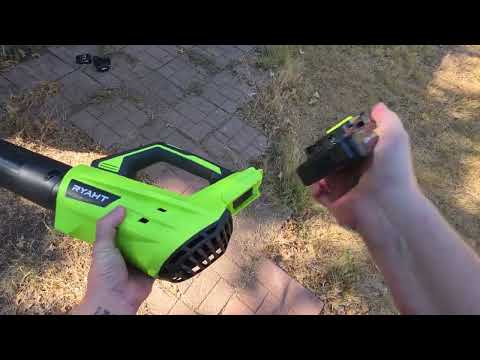
The battery slides onto the blower, and the pack has a small button that indicates remaining battery life. I like having that check available directly on the battery. Before starting a cleanup task, it gives you a way to see the pack’s remaining charge rather than treating battery status as a complete mystery.
The kit includes two batteries and a charger. That matters because a spare battery is a practical convenience in a cordless tool. One battery can be on the blower while the other is available to charge or is already charged and ready to swap in. I removed a battery from the tool, and the process was uncomplicated: it pops off, charges directly in the included charger, and pops back into place when you are ready to use it.
That is the entire battery story in a good way. There is no complicated adapter process described here and no special procedure needed to reinstall the pack. For buyers who are building a simple set of yard tools or who do not want their first cordless blower to feel technical, direct charging and a familiar install-and-remove routine are useful details.
The included second battery should not be mistaken for a stated runtime guarantee. I did not establish minutes of use on low or high, how long the charger takes, or whether the pack works with another battery platform. Those are important questions if you have a large area to maintain or are buying into a broader tool ecosystem. But for the intended convenience of having a ready spare, the two-battery kit is genuinely more flexible than relying on just one pack.
The listing identifies the RYAHT DD8179 as a 20V cordless leaf blower kit with two speed modes, two batteries, and a charger. That listing context matches the battery and two-speed features I handled. The useful distinction is that the kit contents and operation are things I can speak to directly, while runtime and charging performance need to come from information beyond my use.
The tube and nozzle offer broad or directional airflow
The standard setup uses a long blower tube with a larger opening at the end. The kit also includes a smaller nozzle that clips onto the end of that main tube. Adding that smaller piece narrows the outlet so the airflow is more directional.
That gives this cordless leaf blower two uncomplicated ways to be aimed. With the larger tube end, the setup is broader. With the smaller clip-on nozzle installed, I had a more focused direction for the air. The nozzle is not a separate power mode and it does not change the fact that the blower has only low and high settings. It is simply a physical option for concentrating where the air goes.
I see the directional nozzle as most useful when placement matters more than covering a broad space. Edges, corners, and narrower areas are the kinds of situations where deliberately directing airflow can be helpful. The important buyer detail is that the smaller nozzle is a separate attachment. If you switch between the wider and narrower configurations often, you will need to keep track of that piece.
The tube/nozzle assembly can also be detached from the blower. I removed it, and storage is the most sensible reason I can see for doing that. A detachable tube can make the tool less awkward to fit into a closet, on a shelf, or among other garage equipment. It is not a headline feature, but compact storage can make a real difference with a tool designed for quick, regular use.
What this two-speed design is—and is not—built for
The RYAHT DD8179 is most compelling when you want a light cordless blower with a very direct operating experience. Put on the battery, check its charge if needed, choose low or high with the push-up control, and use either the wider tube end or the directional nozzle. Each part of that sequence is uncomplicated.
Low is useful because not every cleanup situation calls for the higher setting. High is available when you want the stronger of the two options. The ability to choose between them is more practical than a one-speed design, while still avoiding the complexity of a variable-speed control. It is a good fit for someone who prefers clear, fixed settings over trying to fine-tune a trigger.
The listing markets the blower for leaves, dust, lawn care, and patio cleaning. Those are intended-use claims, not measured performance outcomes from my time with it. I would treat routine small-area cleanup as the natural buying case based on the tool’s lightweight handling and straightforward controls. That is different from assuming it has been established as the right tool for every kind of debris or property size.
I did not establish performance on heavy, wet, or deeply piled leaves. I also did not measure its airflow, air speed, or noise. If your regular task is moving dense debris across a large property, compare stated airflow specifications, consider your actual cleanup area, and look at a more powerful tool class if necessary. The fact that this blower is easy to handle should not be stretched into a claim that it replaces a larger machine for demanding work.
+ Pros
- Super lightweight handling
- Push-up control avoids holding a trigger continuously
- Low and high speed settings
- Includes a second battery and charger
- Clip-on nozzle provides more directional airflow
- Removable tube can help with storage
! What to know
- The blower uses two fixed speeds, low and high, rather than a continuously variable trigger.
- The directional nozzle is a separate clip-on attachment.
- Runtime, charging time, airflow output, and noise levels were not established.
Who should consider the RYAHT DD8179?
I would consider this cordless leaf blower if your priority is avoiding trigger fatigue. The push-up switch is the defining reason to look at it. You select low or high and let the tool run, rather than holding a trigger throughout the task. For anyone whose finger gets tired using trigger-operated tools, that is not a minor distinction.
It also makes sense for buyers who value lightweight handling. I found it notably light in hand, which makes the tool feel more accessible for routine pickup-and-go work. A spare battery, charge-level indicator button, included charger, clip-on directional nozzle, and removable tube round out a practical ownership package without making the machine feel fussy.
Storage-conscious buyers may appreciate the detachable tube assembly as well. Yard tools can take up more room than expected when their long pieces cannot be separated. Being able to remove the tube is a small but useful option for a crowded garage, shelf, or closet.
When a different cordless leaf blower may fit better
Look elsewhere if variable-speed control is essential. This RYAHT has two fixed positions—low and high—not an infinitely adjustable trigger. That is a real design tradeoff, even though I prefer the switch for avoiding a constant trigger hold.
It may also be worth comparing other options if your purchase depends on verified runtime, charging time, airflow, noise, cross-platform battery compatibility, or long-term durability. I did not establish those items. They should be part of the decision for buyers who need to plan around large spaces, frequent extended sessions, or an existing collection of cordless tools.
Finally, do not buy a lightweight 20V blower assuming it is automatically the answer for wet leaves or deep piles. I cannot say how this model performs in those conditions from my use. Match the tool’s stated specifications to the debris and area you normally deal with rather than buying only on the appeal of a compact design.
Specs
| Spec | Detail |
|---|---|
| Product | RYAHT DD8179 Cordless Leaf Blower, 20V Two-Speed Kit |
| Power platform | 20V cordless |
| Speed settings | Low and high |
| Battery indicator | Button-operated remaining-charge indicator on battery |
| Included power items | Two batteries and charger |
| Tube configuration | Long main tube with removable clip-on directional nozzle |
| Tube removal | Detachable blower tube/nozzle assembly |
Scorecard
Simple battery setup and two-position control.
Very lightweight in my hands.
No need to keep squeezing a trigger.
Second battery and charger add practical flexibility.
Two useful speeds, but no variable output control.
Frequently asked questions
Does the RYAHT DD8179 have variable speed?
No. I used two discrete settings: low and high. The push-up control lets the blower run at the selected setting rather than using a continuously variable squeeze trigger. That is a comfort benefit for buyers who dislike holding a trigger, but it does not provide in-between output adjustment.
Does this cordless leaf blower include two batteries?
Yes. The kit includes two batteries and a charger. I removed and reinstalled the battery on the tool, and I saw the button on the pack that indicates remaining battery life. I did not establish runtime or charging time.
What does the smaller nozzle do?
The smaller nozzle clips onto the end of the long main tube. Its purpose is to make airflow more directional. It is a separate attachment, so it can be installed when you want a more focused outlet and removed when you prefer the larger tube end.
Can the blower tube be removed for storage?
Yes. I detached the blower tube/nozzle assembly. Removing it may make the blower easier to store where shelf depth or available space is limited.
Is it suitable for large piles of wet leaves?
I did not establish performance on heavy, wet, or deeply piled leaves, so I cannot make that recommendation. Buyers with demanding cleanup jobs should compare stated airflow specifications and consider whether a more powerful class of blower better matches their property.
Is the RYAHT DD8179 easy to operate?
Its core operation is simple: install a battery, choose low or high with the push-up control, and aim the tube. The battery comes off for charging in the included charger, and the directional nozzle clips on when you want a narrower airflow path.
Final take on this cordless leaf blower
The RYAHT DD8179 earns its appeal through the basics. It felt very lightweight in my hands, the battery system was easy to handle, the kit includes a useful second battery and charger, and the detachable tube can help with storage. The clip-on nozzle adds a directional airflow option without overcomplicating the setup.
Most importantly, the push-up low/high control eliminates the need to keep squeezing a trigger. If that is a comfort issue for you, it is a meaningful advantage and the strongest reason to consider this cordless leaf blower. Go in knowing that the tradeoff is fixed two-speed operation rather than variable output, and keep unmeasured questions such as runtime, noise, and heavy-debris performance in mind before choosing.
As an Amazon Associate I earn from qualifying purchases.