Cordless Handheld Pool Vacuum: Worth It for Spots?
The InHulk cordless handheld pool vacuum gives you direct control for pool edges, small debris, and visible green spots. The fine filter was the standout in my above-ground pool.
Affiliate disclosure: As an Amazon Associate I earn from qualifying purchases. This article may contain affiliate links, which means I may earn a commission at no extra cost to you.
A cordless handheld pool vacuum is worth considering when the mess is localized and I want to deal with it now. That is where the InHulk cordless handheld pool vacuum fit into my above-ground pool routine. Instead of waiting for a robotic cleaner to eventually drift toward a dirty edge, I could take the vacuum to the debris, visible green spots, and tight areas myself.
That distinction matters. A robot is useful for roaming coverage, but it does not know which spot is bothering me. With this handheld setup, I can choose the area, make repeated passes where needed, and inspect the filter immediately afterward. In my use, that direct control was the biggest advantage—not a claim that it replaces every other pool-cleaning tool.
The package gives me two handle configurations, a standard debris filter plus thicker filters for finer material, and a triangular brushed head. I used the long pole in my above-ground pool, then compared what the standard and thicker filters collected. The thicker filter was the more interesting result because it picked up visibly finer particles in the same general area.
A practical cordless handheld pool vacuum for owners who want to target specific dirty spots instead of waiting on a robotic cleaner. The long pole, triangle brush head, and fine filters make it especially useful for above-ground pool touch-ups.
As an Amazon Associate I earn from qualifying purchases.
Why a cordless handheld pool vacuum is useful for spot cleaning
I like having a robot in the pool, but a robot moves on its own path. It may eventually pass through a problem area, or it may spend time somewhere that does not need attention. A handheld vacuum changes the job from broad, automatic coverage to targeted cleaning. I can see debris, go directly to it, and stay there until I have worked the area as much as I want.
That is especially useful around the pool perimeter. Edges, corners, and individual visible spots are the places where I most value control. If I notice a few small bits of debris rather than a pool-wide mess, I do not necessarily want to wait for another full cleaning cycle. A cordless tool that I can pick up and guide makes more sense for that kind of touch-up.
There is also a practical difference between cleaning loose material and cleaning material that has adhered to a surface. Loose debris can be collected with a pass over the area. Stuck-on material needs more attention. In my cleaning, I used the brushes on the head and worked back and forth over visible green spots until material started coming up. The vacuum is doing more than simply passing over the water; I was actively directing, brushing, and revisiting the area.
For me, that makes this a companion to routine pool care rather than an all-purpose replacement. I would reach for it when I want to take control of a small problem, such as debris along an edge or a patch that needs focused work. I would not expect a manual cordless vacuum to deliver the unattended, whole-pool behavior of a robot.
| Type | Cordless handheld pool vacuum |
|---|---|
| Best use | Targeted above-ground pool and hot-tub cleanup |
| Reach | Two-section pole, roughly 7 feet when extended |
| Cleaning head | Triangular head with small brushes |
| Filtration | Interchangeable debris and thicker fine-particle filters |
| Handle options | Short handle and extendable pole |
My above-ground pool setup: short handle or long pole
The InHulk has two ways to hold it. The included short handle is the close-range option. I see that as the practical configuration for a smaller pool, a hot tub, or any situation where I am near the cleaning area and do not need extended reach. It keeps the setup simple and gives the vacuum a more compact handheld form.
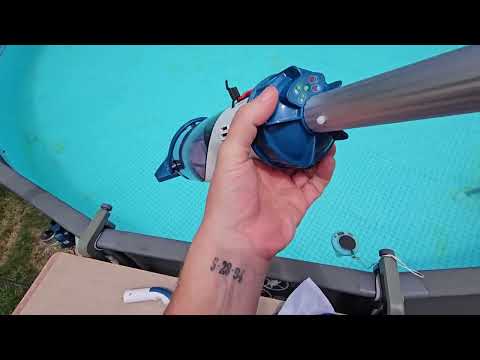
For my above-ground pool, I used the extendable pole. It has two sections, so I could pull it out, secure it, and extend it again. Fully extended, I described it as roughly 7 feet long. That is an estimate rather than an independently measured specification, but it conveys why the pole was useful: it gave me meaningful reach from outside the pool.
I also appreciate that the pole can be shortened. A fixed long handle can be awkward to keep around, particularly if it is longer than I need for a quick cleaning pass. With this one, I can use more reach when I need it and reduce the length when I do not. That is a modest design detail, but it affects both handling and storage.
The pole does not turn a manual cleaner into an automatic one. I still need to guide the head and decide where to work. But the extended reach means I can keep the manual-control advantage without having to be positioned right over every area. For above-ground pool touch-ups, that combination made sense to me.
Buyers should match the handle choice to how they expect to clean. The short handle is about proximity and compact use. The telescopic pole is about reaching into the pool from the side. Since both are included, I can change the configuration instead of trying to make one position work for every cleanup task.
Triangle head, brushes, and edge work
The cleaning head is triangular, with small brushes on it. I found that shape helpful along the pool edges and in tighter spots where a broad, flat head can feel less direct. The triangle does not mean every edge cleans itself, but it gave me a head shape that was easier to place where I wanted it.
The brushes matter when the material is not merely floating or loose. I could use them while moving the head back and forth over visible green spots. That repeated movement was necessary for stuck-on material. There was no one-pass miracle here: I had to work over the spots until they began to lift. That is simply the tradeoff of a hands-on spot-cleaning tool. I get precision, but I also supply the motion and time.
I would frame the triangle head as a useful control feature rather than a reason to expect deep restoration from a neglected pool. It helped me get along edges and work the areas I chose. For an owner dealing with a small, visible trouble spot, that is valuable. For a heavily soiled pool or a large amount of bulky debris, I did not test performance, so I cannot say how it would handle that kind of cleanup.
The overall feel of the setup is straightforward: point the head where the problem is, use the brushes when material needs to be worked loose, and make additional passes when the area calls for it. That is exactly why a cordless handheld pool vacuum can be faster for isolated issues than waiting on a roaming cleaner.
What I found in the standard and thicker filters
The vacuum includes four filters. It came set up with a typical debris filter, and it also includes thicker, sock-like filters intended for finer material. The regular debris filter is the one I would start with when the obvious concern is ordinary pool debris such as dead bugs, leaves, or similar larger pieces.
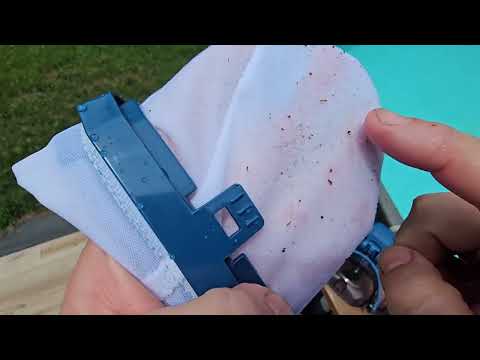
My first pass was brief, and the pool looked fairly clean to me. I did not expect to find much when I opened the collection area. But the standard filter had caught a collection of small pieces that I had not seen in the water with the naked eye. That was a useful reminder that a pool can appear clean while still holding material that a vacuum can collect.
After that, I switched to one of the thicker filters and targeted visible green spots. The stated purpose of the thicker filters is finer material, including algae and microorganisms. My firsthand observation is narrower: after roughly 90 seconds working that area, I found very small particles in the thicker filter. Compared with the standard-filter pass in the same general spot, the thicker filter captured visibly finer material.
That filter choice is the main buyer decision here. If I am dealing primarily with larger debris, the standard filter is the sensible first choice. If I am concerned about very small particles or visible green buildup, I would use the thicker filter. I like having both options because it lets me select the filter based on what I am trying to remove instead of treating every cleaning pass as the same job.
I would not overextend that finding. I did not establish a laboratory filtration rating, nor did I test every type of fine debris. What I can say is that I saw more very small material in the thicker filter after using it on the visible green spots, and that is meaningful for routine, targeted above-ground pool maintenance.

Controls, charging, drainage, and filter cleanup
The controls are simple. There is a covered charging port, a power button, and an indicator light. When I turned the unit on, I could hear the motor running. The indicator light is there to show on/off status and battery power. I prefer this kind of uncomplicated layout on a pool tool because I do not need a complicated interface for a quick spot-cleaning session.
The charging-port cover is worth mentioning because the vacuum is used around water. When I am not charging it, the cover goes back in place. The instructions also say to charge the unit immediately after use. I would treat that as part of the ownership routine: clean the targeted area, inspect and empty the filter, let the vacuum drain, and recharge it as directed.
I did not establish charging time, runtime per charge, battery capacity, or long-term battery behavior. Those are important details for anyone who expects to use one cordless vacuum for extended cleaning sessions. My experience supports this as a touch-up tool, but I would not buy it on an assumption about runtime that I did not test.
Filter removal and reassembly were easy for me. The filter assembly comes off, and I found the rubbery edge easy to get back over the opening when putting it together again. That may sound like a small point, but a filter that is difficult to reinstall can make a simple maintenance job irritating. Here, I could open it, inspect what was collected, clean the filter area, and put it back together without much fuss.
One operational point stood out: the vacuum releases a substantial amount of water when I lift it from the pool. Before opening the collection or filter area, I used the quick-release/draining area at the rear and gave it time to drain. That keeps the cleanup process more manageable. It is not a product defect, but it is a practical habit buyers should expect to adopt.
Where this handheld vacuum fits in a pool-care routine
I would use this InHulk cordless handheld pool vacuum for routine targeted cleanup: the debris I can see, the edge I want to revisit, the small particles I want to check for, or the visible green spots that need focused brushing. It gives me a direct way to respond to those issues without setting up a corded system or waiting for a robot to navigate there.
For above-ground pool owners, the long pole is a key part of the appeal. Roughly 7 feet of extended reach made side-of-pool cleaning more realistic for me. For hot-tub owners and smaller-pool owners, the short handle may be the better everyday configuration because the cleaning area is closer and a long pole may be unnecessary.
The filter system is the other reason I would choose this over a bare-bones handheld option. The standard filter gives me a normal debris option, while the thicker filters give me a separate choice when fine material is my concern. My cleaning pass supported that distinction: I found small debris with the standard filter and visibly finer particles with the thicker one.
This is best for the person who prefers to steer the cleaning process. If I see a dirty area, I do not have to wait for an automated cleaner to reach it. I can work it immediately, inspect the collection area, and decide whether the result calls for another pass. That feedback loop is the real strength of a manual cordless model.
Reasons to choose a different cleaning approach
I would skip this if my expectation is fully automatic, hands-off cleaning. This vacuum is manual by design. I need to guide it, make repeated passes on material that is stuck on, empty the filter, allow it to drain, and recharge it after use. Those are normal responsibilities for a handheld pool vacuum, but they are different from dropping in a robot and letting it roam.
I would also look elsewhere if my main need is a major cleanup involving a heavily soiled pool, lots of large leaves, or unknown long-session runtime. I did not test suction performance on larger leaves or heavier debris, and I did not establish how long the battery runs on a charge. Nothing in my use gives me a basis to make a strong claim about those scenarios.
Likewise, I did not evaluate long-term durability, replacement-filter availability, or performance on every pool surface. Those are sensible questions to investigate before choosing any pool vacuum as a primary cleaner. My recommendation is deliberately narrower: this is a practical cordless option for localized cleanup in an above-ground pool, hot tub, or similar setting where direct control matters more than unattended coverage.
+ Pros
- Direct manual control for targeting debris and visible green spots
- Two-section pole provides roughly 7 feet of reach when extended
- Short handle and telescopic pole support different cleaning positions
- Triangular brushed head works well along edges and on adhered material
- Collected small debris that was not obvious in the pool
- Thicker filter captured finer particles than the standard debris filter
- Rubbery filter edge was easy to reassemble
! What to know
- This is a manual spot-cleaning tool, not an automatic robotic cleaner.
- Stuck-on material needs repeated back-and-forth passes with the brushed head.
- Let the vacuum drain before opening the filter area; it releases substantial water when lifted from the pool.
- The instructions say to charge the unit immediately after use.
InHulk cordless handheld pool vacuum buyer guide
The simplest buying question is not “Can this clean a pool?” It can collect debris and fine particles in the targeted areas I worked. The better question is whether its manual format matches the way I want to maintain my pool. If I prefer to identify a problem and personally direct the tool at it, the answer is likely yes.
Choose the long pole configuration if I need reach from outside an above-ground pool. Choose the short handle if I am cleaning close by, working in a hot tub, or using a smaller pool where a long pole is more cumbersome than helpful. The flexibility of getting both configurations is more useful than being locked into a single fixed handle.
Then choose the filter for the task. I would start with the standard debris filter for typical visible debris. I would move to the thicker filter when the goal is finer material or visible green buildup. The latter is not just listing copy in my experience; I actually found much smaller particles after using the thicker filter in the area I cleaned.
Finally, account for the cleanup routine. The unit needs to drain after it comes out of the pool, and the instructions say to charge it immediately after use. Neither requirement is difficult, but both are part of using it smoothly. Buyers who want a tool they can grab for five-minute touch-ups should be comfortable with those final steps.
Specs
| Spec | Detail |
|---|---|
| Product | InHulk cordless handheld pool vacuum |
| Power design | Cordless rechargeable |
| Included filters | Four filters, including a standard debris filter and thicker sock-like filters |
| Pole | Two-section telescopic pole; roughly 7 feet fully extended according to Scott |
| Head shape | Triangle-shaped head |
| Brushes | Small brushes on the cleaning head |
| Controls | Power button and visible status/battery indicator light |
| Charging port | Covered charging port |
| Drainage | Rear quick-release/draining area |
Scorecard
Lets you target specific debris and dirty spots directly.
Short handle plus a roughly 7-foot telescopic pole.
Thicker filter captured visibly finer particles in use.
Triangle head and brushes were useful along edges.
Filter was easy to reinstall, but draining first is important.
Frequently asked questions
Can this cordless handheld pool vacuum reach across an above-ground pool?
It includes a two-section telescopic pole that I extended to roughly 7 feet. That estimate gave me useful reach for cleaning from the pool side. The included short handle is the better choice for close-range work, smaller pools, or hot tubs.
Does the InHulk vacuum pick up fine debris?
Yes. During my first brief pass, the standard filter collected small debris that I had not noticed beforehand. When I switched to the thicker filter and worked visible green spots, I found visibly finer particles after roughly 90 seconds. I would use the thicker filter when fine material is the priority.
Can it clean algae or green spots?
I used a thicker filter while working over visible green spots. The head has brushes, but stuck-on material required repeated back-and-forth passes until it started coming up. It is a manual spot-cleaning process, so I would expect to spend time working the affected area rather than relying on a single pass.
Is the filter easy to empty and reinstall?
I found the filter assembly easy to open and reinstall, in part because its edge had a rubbery feel that helped it fit back over the opening. Before opening the filter area, I let the vacuum drain through the rear draining area because a substantial amount of water comes out after lifting it from the pool.
Is this a replacement for a robotic pool cleaner?
No. I see it as a complementary tool for direct, localized cleanup. A robot is useful for automatic roaming coverage, while this handheld vacuum lets me target the exact debris, edge, or visible spot I want to address. It is manual, so I still provide the steering and cleaning passes.
What battery information did I confirm?
I confirmed that it has a covered charging port, a power button, and an indicator light for on/off status and battery power. The instructions say to charge it immediately after use. I did not establish charge time, runtime per charge, battery capacity, or long-term battery performance.
Final recommendation
I would recommend the InHulk cordless handheld pool vacuum to pool owners who want direct control over small cleanup jobs. The long adjustable pole gave me the reach I wanted for my above-ground pool, while the short handle provides a more compact option for close-range use. The triangle head and small brushes were useful for edges and visible spots, especially when I needed to make repeated passes.
The most convincing part of my use was the filter comparison. The standard filter picked up small debris I had not seen, and the thicker filter captured visibly finer particles after I worked the green spots. If your goal is targeted touch-up cleaning rather than completely automated pool maintenance, this is a practical cordless tool to keep in the routine.
As an Amazon Associate I earn from qualifying purchases.