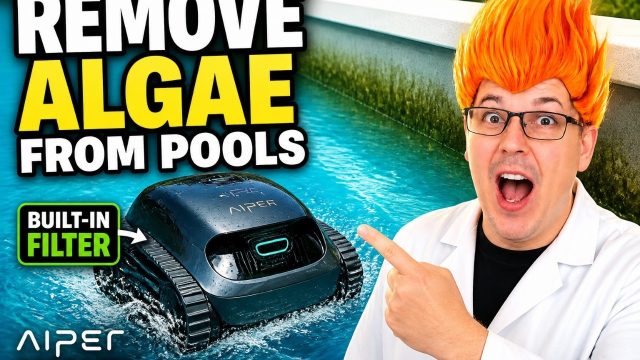
Cordless Robotic Pool Cleaner: Aiper Scuba S1 Review
The Aiper Scuba S1 climbed the deep-end walls of my in-ground pool without a cable. Its wall, floor, combined, and Eco modes are the practical reason to consider it.
Affiliate disclosure: As an Amazon Associate I earn from qualifying purchases. This article may contain affiliate links, which means I may earn a commission at no extra cost to you.
If you are shopping for a cordless robotic pool cleaner, the question is not simply whether it moves around underwater. For an in-ground pool, I want to know whether it can actually travel up a vertical wall, how it behaves in the deep end, and whether its modes match the maintenance job at hand. The Aiper Scuba S1 gave me a useful answer to those questions in my own pool: it climbed the wall in the deep end, moved up and down while submerged, and did it without a cable trailing through the water.
That wall movement is the reason this model stands out to me. Plenty of pool-cleaning decisions come down to convenience, but a cordless format alone would not matter much if the robot stayed on the floor. I watched the Scuba S1 work vertically, back up, turn, and continue its pattern on the wall. It also offers separate wall-only, floor-only, combined, and Eco modes, so the feature set has a clear connection to how I would use it rather than reading like a list of settings for their own sake.
The Aiper Scuba S1 is a strong fit for in-ground pool owners who want a cordless robot that can visibly climb deep-end walls and let them choose wall, floor, combined, or Eco cleaning cycles.
As an Amazon Associate I earn from qualifying purchases.
My pool was overfilled after a heavy rainstorm, which created one important condition to keep in mind. The robot is meant to come out of the water a little at the top of its climb, but the water was right at the edge in my pool. It could still travel up and down the wall, but there was no room for it to get its intended clearance above the waterline. That is a water-level issue worth understanding before judging a wall-climbing robot at the top edge of a pool.
| Pool type | In-ground pools |
|---|---|
| Power format | Cordless |
| Wall cleaning | Observed on deep-end vertical wall |
| Cleaning modes | Wall, floor, combined, and Eco |
| Navigation | Aiper WavePath 2.0 |
Who should buy this cordless robotic pool cleaner?
I would consider the Scuba S1 if you own an in-ground pool and your priority is getting a cable out of the pool while retaining the ability to clean vertical walls. In my use, it was not just a floor rover. It went up and down the deep-end wall, where the depth did not stop its wall-cleaning movement. That is especially relevant for shoppers who are trying to decide whether a cordless robot can handle more than the bottom of the pool.
This is also a sensible match for someone who wants choices rather than one fixed cleaning routine. There are times when a full wall-and-floor pass makes sense, but there are also times when the floor is not the issue. If the walls are the area you want to prioritize, wall-only mode gives that task its own cycle. Conversely, floor-only mode avoids asking the robot to spend time on walls when bottom maintenance is all that is needed.
The Eco setting is another example of a mode with a specific use. It is described as a vacation-style maintenance option rather than a standard continuous cleaning cycle. It runs for 50 minutes every 48 hours over a five-day period, with a day off in the sequence. For someone leaving the pool unattended for a short period, that cadence may be more useful than a single long run. For someone standing poolside and wanting a complete cleaning pass today, combined, wall-only, or floor-only mode is the more direct choice.
I would not treat the Scuba S1 as an automatic answer to every pool-maintenance need. I did not independently measure debris pickup, filtration results, battery runtime, recharge time, or complete coverage of my pool. I also did not separately test steps, corners, shallow areas, every section of the floor, or multiple pool surfaces. My recommendation rests on what I actually observed: cordless operation, deep-end wall movement, its backing-and-turning pattern, and the available cleaning-mode choices. Before buying, match Aiper’s current compatibility guidance to your particular pool.
My Aiper Scuba S1 wall-climbing experience
I watched the Scuba S1 operating on the walls of my in-ground pool. In the deep end, it traveled upward along the vertical wall while fully submerged, then moved back down and continued working. For this kind of product, that is the central behavior I wanted to see. A robot moving around a pool floor is one thing; a robot maintaining traction and traveling vertically in the deep end is a more meaningful test of whether wall cleaning belongs in the buying decision.
The unit worked cordless, with no wires involved. There was no cable in the water to manage as it moved around the pool. That is a straightforward convenience benefit, but it also changes the everyday routine: there is no floating cord alongside the robot during the cycle. If cable management is the part of a traditional pool robot setup that you dislike most, the Scuba S1’s format directly addresses that annoyance.
I could see the movement pattern Aiper calls WavePath 2.0. On the wall, the robot backed up and turned, creating an in-and-out pattern rather than simply traveling straight upward and stopping. I am not using that observation to make a broad coverage claim for every pool shape. I did, however, see deliberate repositioning as it worked on my wall. Aiper describes WavePath Navigation Technology 2.0 as its navigation system for floors and walls, and the backing-and-turning behavior was visible in my pool.
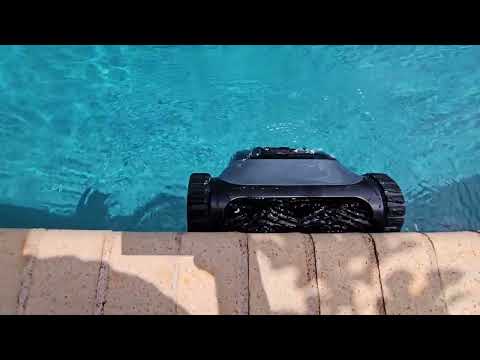
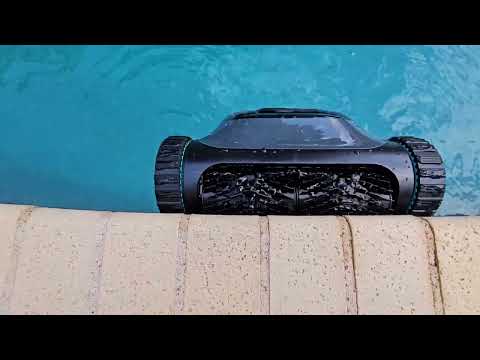
The deep end is worth calling out because it removes a common uncertainty for shoppers looking at a wall-climbing pool robot. The wall I watched was in the deep end, and the Scuba S1 continued traveling up and down there. I did not have to infer its vertical movement from a shallow-wall example. That does not mean every pool profile, transition, corner, or surface will behave identically, but it does mean depth itself was not the thing preventing wall operation in my use.
The main wrinkle was the unusually high water level. A recent rainstorm had overfilled my pool, leaving the water right at the edge. The intended behavior is for the Scuba S1 to come out of the water a little at the top of the wall for several seconds. Because there was effectively no exposed area above the waterline, it could not do that in my pool. It still went up and down the wall, but the top-of-wall result was shaped by the pool condition, not a normal water level.
That distinction matters if your shopping goal is waterline-focused cleaning. I saw active wall movement at the water’s edge, but I did not independently assess removal of established waterline buildup. What I can say is that an overfilled pool takes away the clearance a robot expects at the upper edge. Keep the water at its normal operating level if you want to assess how a wall-climbing cleaner behaves at that boundary.
Why the cleaning modes matter more than a feature checklist
The Scuba S1 has combined wall-and-floor, floor-only, wall-only, and Eco modes. Aiper also identifies these modes as Floor, Wall, Automatic, and Periodic/Eco. The labels matter less than the practical choices behind them: you can aim a cycle at the part of the pool that needs attention instead of using the same all-purpose run every time.
In the combined setting I used, the robot was set to spend the first half of its stated three-hour cycle cleaning walls and the second half cleaning floors. That arrangement makes sense as a standard maintenance cycle when you want both surfaces addressed. It also explains why a combined cycle is not necessarily the best answer for a wall-specific job. If the wall is your concern, wall-only mode dedicates the stated three hours to that area. If the floor is all you need, floor-only mode does the same for the bottom.
- Combined wall and floor: Best suited to a routine whole-pool cycle when you want the robot to divide its time between both surfaces.
- Wall-only: The logical setting when vertical surfaces are your main priority and you do not want the cycle split with floor cleaning.
- Floor-only: A practical option for bottom maintenance when wall cleaning is not needed.
- Eco: A periodic schedule of 50 minutes every 48 hours over five days, with a day off in the sequence; useful as a maintenance-oriented option when you are away.
I like that these are not vague “smart” settings that leave the buyer guessing what will happen. Each one maps to a recognizable pool-care decision. The combined mode is for a broad pass. Wall-only and floor-only modes let you focus the cycle. Eco changes the timing from one continuous session to periodic upkeep. That is useful flexibility without requiring an assumption that every owner should run the same pattern.
The stated three-hour durations are descriptions of the mode settings, not runs that I independently timed. Likewise, the manufacturer lists battery life of up to 180 minutes, but I did not conduct a battery-runtime measurement. If exact runtime is a deciding factor for your pool size or schedule, treat the published number as a manufacturer claim and confirm the current product information before purchasing.
+ Pros
- Climbed and traveled on my in-ground pool's deep-end walls
- Cordless design keeps a cable out of the pool
- Selectable wall-only, floor-only, combined, and Eco cleaning modes
! What to know
- An overfilled pool can keep the robot from reaching its intended position above the waterline.
- I did not independently measure battery runtime, recharge time, debris pickup, filtration results, or full-pool coverage.
- Aiper lists compatibility with concrete, fiberglass, vinyl, and tile pools; I used it only in my own in-ground pool.
Pool conditions to consider before choosing the Scuba S1
First, I would start with pool type. Aiper positions the Scuba S1 as a cordless cleaner for in-ground pools, which is the environment where I used it. Aiper lists concrete, fiberglass, vinyl, and tile among its compatible surfaces. I only used the robot in my own in-ground pool, so I cannot speak from my use about its performance on each of those surface materials. Compatibility guidance should be part of the purchase check, not an afterthought after delivery.
Second, consider your water level. My overfilled pool is a clear example of why it matters. The water was at the edge after heavy rain, so the robot could not emerge above the waterline as intended. It retained its up-and-down wall movement, but the top-edge behavior was limited by the lack of clearance. This is not a complicated product complaint; it is a useful operating condition to remember whenever you are evaluating wall or waterline movement.
Third, decide whether cordless convenience is valuable enough for your routine. The Scuba S1 operated without a wire in my pool. For owners who dislike handling a cable or seeing one floating alongside the cleaner, that can be a major quality-of-life improvement. For shoppers whose sole priority is a particular measured filtration result, debris capacity, or charging schedule, I did not test enough to make this review the final word on those factors.
Finally, separate demonstrated behavior from questions that still deserve your own research. I saw the Scuba S1 climb a deep-end wall, move while submerged, and reposition through its backing-and-turning pattern. I did not test every floor section, steps, corners, shallow sections, different surface materials, or post-cleaning debris results. That does not reduce the value of the wall-climbing observation; it simply keeps the buying case focused on the evidence I have.
Manufacturer-listed specifications in context
Aiper lists the Scuba S1 with a 3.5 L filter basket, a claimed 4,200 GPH flow rate, and battery life of up to 180 minutes. Those are useful comparison points if you are narrowing down several models, but they are manufacturer specifications rather than figures I independently verified. The same goes for the listed surface compatibility and the WavePath Navigation Technology 2.0 name.
For my buying decision, I would use the specifications as a fit check and put the most weight on the behavior I observed in the pool. The demonstrated takeaway is clear: this cordless robotic pool cleaner traveled on the deep-end wall of my in-ground pool and offered modes that let me choose walls, floors, both, or a periodic maintenance schedule. The specifications help determine whether that demonstrated behavior fits your pool’s requirements.
Specs
| Spec | Detail |
|---|---|
| Product | Aiper Scuba S1 Cordless Robotic Pool Cleaner |
| Cleaning modes | Floor, Wall, Automatic/combined, and Periodic/Eco |
| Claimed battery life | Up to 180 minutes (Aiper claim) |
| Filter basket | 3.5 L (Aiper claim) |
| Claimed flow rate | 4,200 GPH (Aiper claim) |
| Listed pool surfaces | Concrete, fiberglass, vinyl, and tile (Aiper claim) |
| Navigation | WavePath Navigation Technology 2.0 |
How I scored the Aiper Scuba S1
Wall climbing earns the strongest score because I watched the robot travel up and down the vertical wall in my deep end. Cordless convenience also scores highly because no cable was involved during operation. The mode score reflects the usefulness of having distinct wall, floor, combined, and Eco choices instead of a one-cycle-only approach.
I scored waterline conditions more cautiously. The robot continued traveling on the wall in my overfilled pool, but the excess water prevented the intended emergence above the waterline. That is a condition-specific caveat rather than a reason to disregard the robot, and it is why I would check water level before expecting top-edge behavior.
Scorecard
Climbed the deep-end wall in my pool.
No cable in the pool during operation.
Useful wall, floor, combined, and Eco choices.
An overfilled pool limits top-edge clearance.
Frequently asked questions about this cordless robotic pool cleaner
Can the Aiper Scuba S1 climb pool walls?
Yes. I watched it travel up and down the vertical wall of my in-ground pool, including in the deep end. It was submerged while moving on that wall.
Does the Aiper Scuba S1 use a cord?
No. It operated cordless in my pool, with no wire in the water. That is one of its clearest practical advantages for owners who do not want to manage a floating cable during a cleaning cycle.
What cleaning modes does the Scuba S1 offer?
It offers combined wall-and-floor, floor-only, wall-only, and Eco modes. Aiper also lists these as Floor, Wall, Automatic, and Periodic/Eco. In the combined setting described here, the first half of the stated three-hour cycle is for walls and the second half is for floors.
What does Eco mode do?
Eco mode is described as a periodic, vacation-style maintenance setting. It runs for 50 minutes every 48 hours over a five-day period, with a day off in the sequence. It is a different use case from a single continuous wall-only, floor-only, or combined cycle.
What happens when the pool water is too high?
My pool was overfilled after heavy rain, with water right at the edge. The Scuba S1 could still travel up and down the wall, but it could not get out above the waterline as intended because there was no clearance available.
How long does the Aiper Scuba S1 run?
Aiper lists battery life of up to 180 minutes. Wall-only and floor-only modes were described as stated three-hour cycles, while the combined mode divides its stated three hours between walls and floors. I did not independently time battery runtime or a complete cycle.
Does this review confirm debris pickup or waterline-stain removal?
No. I did not independently measure debris pickup, filtration performance, or removal of established waterline buildup. My firsthand observations are limited to cordless operation, deep-end wall movement, the visible WavePath 2.0-style backing-and-turning behavior, mode choices, and the effect of an overfilled pool.
Final take on the Aiper Scuba S1
The Aiper Scuba S1 makes a convincing case if your priority is a cordless in-ground pool robot that can work on vertical walls. I watched it climb and reposition on my deep-end wall, and I like that the cleaning modes correspond to actual maintenance choices: wall-only when the walls need attention, floor-only for bottom maintenance, combined for a broader pass, and Eco for periodic upkeep.
The main buyer caveat from my use is simple: water level affects what happens at the top edge. With my pool overfilled after rain, the robot did not have room to emerge above the waterline as intended, even though it still moved up and down the wall. Keep that condition in mind, confirm manufacturer compatibility for your pool, and do not assume results I did not measure. On the evidence I saw, the central appeal held up: no cable, real deep-end wall movement, and useful cycle choices.
As an Amazon Associate I earn from qualifying purchases.