Lighted Christmas Village Gas Station: Worth Adding?
This lighted ceramic gas station adds a sturdy, nostalgic roadside stop to a Christmas village without taking over the display.
Affiliate disclosure: As an Amazon Associate I earn from qualifying purchases. This article may contain affiliate links, which means I may earn a commission at no extra cost to you.
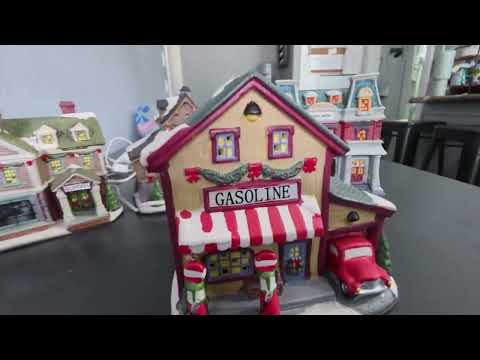
If your display needs a business or roadside stop instead of one more house, this lighted Christmas village gas station gives it a different kind of personality. I found it to be a compact ceramic building with an old-school look, useful interior illumination, and enough molded detail to make it feel like a real destination in a village scene. It is not a giant centerpiece, which is exactly why I think it can be an easy addition for a shelf, mantel, tabletop, or a larger holiday layout.
The appeal is straightforward: a village feels more like a place when it has more than homes. This gas station supplies that bit of everyday activity. There are old-style pumps, stacked tires, oil barrels, a truck-area detail, and a small exterior light detail. Once the internal bulb is on, those features read more clearly than they do in ordinary room light. I also liked the substantial feel of the ceramic body and the soft bottom that helps protect the surface underneath it.
A strong pick for village collectors who want a compact, nostalgic service-station building. The lighting brings the details to life, the ceramic body feels substantial, and the roughly 8 x 6 x 7 inch size is easy to place if you can access the rear switch.
As an Amazon Associate I earn from qualifying purchases.
| Type | Lighted ceramic Christmas village building |
|---|---|
| Theme | Old-school gas station |
| Approximate size | 8 W x 6 D x 7 H inches |
| Lighting | Internal bulb with rear switch |
| Base | Soft protective bottom |
Why this lighted Christmas village gas station stands out
A Christmas village can become visually repetitive when every building is a house, shop, or church. A gas station changes the story of the layout without requiring a large lot. It gives a village a roadside-service element that works naturally beside a road, near a parking area, or at the edge of a group of buildings. The subject here is clearly nostalgic rather than modern: the station uses old-school styling that suits traditional holiday village décor.
I particularly noticed that the details are not limited to a single front-facing view. As I looked around the piece, I could see stacked tires on one side, oil barrels, old-style gas pumps, and the small exterior light detail. That wraparound approach matters for anyone who builds a display that viewers can see from an angle or from more than one side. A miniature building does not need to have activity on every inch of its exterior, but it benefits from having enough side detail that it still belongs in the scene when it is not pointed straight at the room.
The station also has a little more character than a plain ceramic building because the details suggest what happens there. The tires, barrels, and pumps all reinforce the same service-station theme. I would use it where the road changes direction, at the entrance to a village, or beside a small open area rather than hiding it in a back row. It does not need to dominate the display to be noticed; it simply gives the layout a useful change of pace.
For someone building a village gradually, that is a meaningful buying point. A specialty building can add variety sooner than another similar house can. If your existing scene already has enough residential structures, this is the kind of piece that can make the layout feel less like a cluster of individual ornaments and more like a tiny town with different stops along the way.
The ceramic build feels made for display duty
This is a ceramic building, and in my handling it had good weight. That gave it a sturdier, more substantial feel than a light decorative shell. I would still treat any ceramic village piece carefully when setting up, packing away, or rearranging it, but the station did not feel flimsy or disposable in hand. Its weight also helps it feel appropriate as a standalone seasonal accent, not only as one component among many buildings.
The soft bottom is a small feature that I genuinely appreciate. Village layouts often move around while I decide where roads, trees, and buildings look best. A bottom designed to help avoid scratching the surface makes the piece friendlier to use on a finished shelf, tabletop, mantel, or bookcase. It does not eliminate the need to handle ceramic décor carefully, but it is a practical touch for the surfaces where holiday displays usually end up.
That combination of ceramic weight and a soft base is why I see this as a flexible display piece. In a full village, it has the presence of a proper building rather than a lightweight accessory. On its own, it has enough substance to work as a small illuminated holiday decoration. If you only set out a few pieces each year, the gas-station theme gives you a more unusual choice than a standard house while retaining the warm, traditional feel associated with a Christmas village.
I did not test long-term durability of the ceramic finish, the internal light assembly, or the rear switch. I also did not establish replacement-bulb availability. My build-quality impression is based on handling this unit: it felt sturdy and nicely weighted, and the soft base is useful for the surfaces where I would expect to display it.
Lighting is what brings the station scene forward
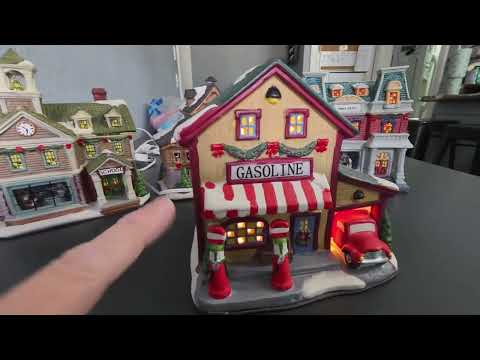
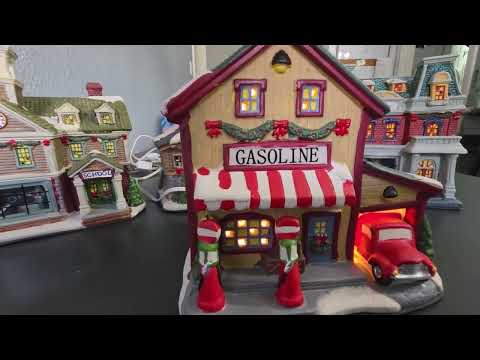
The main feature is the internal bulb located at the back of the building. There is a switch there as well. With the light off, I still found the gas station appealing as a ceramic miniature. With the switch on, it becomes much more convincing as a village building because the illumination makes the windows and interior garage/display area visible.
I could see light behind the truck-area detail, and the glow came through windows around the building when I turned it to the side. That side-window effect is important because it gives the piece visual interest beyond its front. Instead of looking like a solid object with a single lit face, it has a more occupied appearance from multiple angles. The internal light adds depth to the details already molded into the building rather than serving as a separate gimmick.
This lighting makes the gas station especially suitable for an evening display. Many holiday village details become less noticeable when the room gets dimmer or when the overall layout is lit mostly by its own buildings. Here, the illumination helps the station remain part of the scene. It makes the windows more legible, draws attention to the interior area, and gives the old-school exterior details a warmer backdrop.
The important placement consideration is access. Because the bulb and switch are at the back, I would not bury that side tightly against a wall or surround it with permanent-looking snow, trees, or other buildings before deciding how I will turn it on and off. Leaving a little space behind the station is the easy solution. It is a modest planning requirement, but it is worth considering before committing to a final layout.
I did not confirm bulb type, cord length, electrical rating, whether a replacement bulb is available, or whether a bulb is included separately from the unit. What I can say from using this piece is that the rear switch operated the internal light and that the illumination was visible through the windows and in the interior display area.
Size and placement for shelves, mantels, and village roads
I measured this gas station at about 8 inches wide, about 6 inches deep, and right around 7 inches tall. Those are manageable dimensions for a building that has enough visual detail to make an impact. The 8-by-6-inch footprint should be approachable for many tabletop setups, while the roughly 7-inch height gives it enough presence without asking for a tall display space.
For a shelf or bookcase, I would start with the stated footprint and then add a little breathing room. The building needs roughly 8 inches of width and 6 inches of depth, but the rear switch means it is wiser not to use every last inch of available depth. The same thinking applies to a mantel or side table: account for the piece itself, then keep the back reachable for lighting control.
In a larger village, I think its proportions make it easiest to use as a roadside building or a corner destination. It can sit next to a village street, near trees, or between larger structures without becoming a traffic jam for the rest of the arrangement. The old-style pumps and other details help it read as a station even when it is part of a busier scene, so it does not need an oversized empty area around it.
The dimensions also support using it individually. If you do not create an entire village, the station can still make sense on a bookshelf, tabletop, mantel, or entryway surface as a small lighted ceramic accent. Its windows and interior illumination give it an evening-friendly quality, while the themed exterior prevents it from feeling like a generic light-up building.
Exact scale compatibility with specific Christmas-village brands or collections was not established. I thought it went well with the other village units from the same brand, but I would not assume it precisely matches every collection. If exact scale is important in your display, compare the approximate 8-inch width, 6-inch depth, and 7-inch height with your existing buildings before deciding where it will go.
Who this nostalgic service station makes sense for
I would recommend this first to Christmas village collectors who want to add a roadside or service-station setting. It is a natural choice when a collection has plenty of homes but needs a building with a different role. The design is also a fit for anyone drawn to old-school gas-station details rather than a sleek or contemporary miniature style.
It is also a solid option for decorators with limited display space. The approximate footprint is compact enough for a shelf, mantel, tabletop, or bookcase, and the station has enough detail to work on its own. That standalone flexibility matters because not every holiday decorator has room to build a full village with roads, trees, and multiple structures every season.
Buyers who enjoy lighting their village should get the most from it. The bulb brings out the windows and the interior garage/display area, which is a large part of the piece’s appeal. If you prefer every building in a display to light up, this one belongs in that conversation. If you want a decorative object that stays interesting in both daylight and lower room light, its ceramic exterior and internal illumination work together well.
I would look elsewhere only if rear access is impossible in your planned spot or if your available surface is smaller than the approximate footprint. This is not a building I would place flush against a wall and forget about, since the rear switch needs to remain usable. It is also not the right choice for someone who needs verified compatibility with a particular village scale, because that exact comparison was not confirmed.
My practical setup priorities
If I were working this piece into a village, I would decide on access before decorating around it. I would place the station where I can reach the back switch without shifting surrounding pieces. That might mean using it at an outer edge of the display, leaving a narrow gap behind it, or positioning it so one side remains open. The goal is not to make the back a visual feature; it is simply to avoid making routine light control inconvenient.
After that, I would let the station’s details guide the composition. The old pumps, tires, barrels, and small exterior light detail give it enough personality to sit near a road or open area. Its approximate size means it should not need a huge dedicated lot. A compact placement can be more effective than isolating it, since a gas station naturally feels connected to the rest of a town.
For a standalone display, I would prioritize a surface where the soft bottom can do its job and where the cord and rear switch are easy to manage. The ceramic weight gives it a satisfying presence, and the lit windows provide the seasonal visual payoff. It is a simple decorating decision: use it when you want a compact holiday building with a clear theme, not when you need a large focal point or a precisely scale-matched architectural model.
+ Pros
- Internal light reveals the windows and interior garage/display detail.
- Ceramic construction felt sturdy and substantially weighted.
- Soft bottom helps protect the display surface.
- Nostalgic gas-station details add variety to a village scene.
- Compact footprint works on shelves, tabletops, mantels, and in larger displays.
! What to know
- The light switch is at the rear, so that side needs to stay accessible.
- Plan for roughly 8 inches of width, 6 inches of depth, and 7 inches of height, plus rear clearance for the cord and switch.
- Exact scale compatibility with particular village brands was not confirmed.
Details and limits I could confirm
The supported strengths here are clear: ceramic construction, a soft protective bottom, an old-school gas-station theme, detail on multiple sides, approximate 8 x 6 x 7 inch dimensions, and rear-operated internal lighting that shows through the windows and interior area. Those are the characteristics I would use to make a buying decision.
There are also a few things I cannot fill in. I did not establish the exact bulb specification, cord length, electrical rating, replacement-bulb options, or long-term durability of the finish and lighting components. None of those unanswered details changed my immediate impression of the unit, but they are worth recognizing if one of them is important to your setup or storage plans.
The measured dimensions are approximate because I took rounded measurements while checking the building. For planning purposes, I would treat 8 inches wide, 6 inches deep, and 7 inches tall as a practical minimum space guide, then leave additional room at the back for the switch and cord access.
Specs
| Spec | Detail |
|---|---|
| Material | Ceramic |
| Approximate width | 8 inches |
| Approximate depth | 6 inches |
| Approximate height | 7 inches |
| Light source | Internal bulb |
| Light control | Switch at rear of building |
| Lighting effect | Illuminates interior area and windows |
| Base | Soft bottom |
Scorecard
Ceramic body felt sturdy and nicely weighted.
Window and interior illumination adds useful depth.
Compact enough for a full village or standalone accent.
Tires, barrels, pumps, and exterior details create a convincing scene.
Rear switch means you need access behind the building.
Frequently asked questions
What size is the lighted ceramic gas station?
I measured it at approximately 8 inches wide, 6 inches deep, and 7 inches tall. Those rounded dimensions make it compact for a village display, shelf, tabletop, mantel, or bookshelf. I would also leave additional depth behind the building so the rear switch remains accessible.
Does this Christmas village gas station light up?
Yes. It uses an internal bulb at the back of the building, operated by a switch in that same area. When I switched it on, light was visible in the interior garage/display area behind the truck detail and through windows around the structure.
Is the gas station ceramic or plastic?
It is ceramic. In my handling, it had good weight and felt sturdy. The bottom is soft, a useful feature intended to help avoid scratching the display surface when the building is placed or moved.
Can I use it without building a full Christmas village?
Yes. The roughly 8 x 6 x 7 inch size and the lit windows make it suitable as an individual holiday accent on a shelf, mantel, tabletop, or bookcase. It has enough exterior detail to hold visual interest without surrounding village buildings.
What details are on the outside of the station?
I noted stacked tires, oil barrels, old-style gas pumps, and a small exterior light detail. The detailing extends around the building, which helps it look appropriate when viewed from more than one angle in a display.
Will it match my current village collection?
The nostalgic service-station theme should blend into many village scenes, and I thought it paired well with other units from the same brand. However, I did not confirm exact scale compatibility with specific village collections, so compare its approximate dimensions with your existing buildings if matching scale is a priority.
What should I plan for before placing it in a display?
Plan for approximately 8 inches of width, 6 inches of depth, and 7 inches of height. Most importantly, keep the back reachable because that is where the internal bulb and light switch are located. A tightly packed, wall-flush placement could make the switch inconvenient to use.
Final take
I would add this lighted Christmas village gas station when I wanted more story and variety in a holiday layout without giving up much space. The ceramic body felt substantial, the soft base is a practical surface-friendly detail, and the nostalgic pumps, tires, and barrels give it a specific purpose in a village. The internal bulb is the feature that finishes the effect by lighting the interior area and windows around the building.
It is best for someone who can leave the rear switch accessible and who wants a compact, old-school roadside building rather than another house. With that small placement consideration handled, I think it is a convincing and versatile addition for both full Christmas villages and smaller standalone holiday displays.
As an Amazon Associate I earn from qualifying purchases.