Solar Pool Skimmer: Is the Anpool P1 Practical?
The Anpool P1 brings solar power, a backup charger, a removable basket, and a pole hook to surface-skimming duty. The hands-on details are promising, with a few real-world questions still worth considering.
Affiliate disclosure: As an Amazon Associate I earn from qualifying purchases. This article may contain affiliate links, which means I may earn a commission at no extra cost to you.
The Anpool P1 is a solar pool skimmer built for one focused job: collecting the leaves, bugs, and other material floating on top of pool water. That narrow purpose is important. This is not a floor vacuum, a wall scrubber, or a replacement for your circulation and filtration system. It is a floating helper for the surface layer, where debris can otherwise keep drifting around until you grab a net.
In my hands, the practical details stood out more than flashy claims. Sunlight activated the rear fans, a wall-charging accessory came in the box, the front rollers felt smooth, and the debris basket came out without a fight. Those may sound like small things, but they affect whether a pool gadget feels convenient once it becomes part of your maintenance routine.
My main takeaway is straightforward: the P1 has a sensible feature set for someone who wants a cordless surface-debris machine with solar assistance but does not want to depend exclusively on sunny conditions. I would still keep expectations grounded. I did not measure runtime, watch it complete a cleaning cycle in a pool, or test its navigation around a particular pool shape. If those details decide the purchase for you, treat the advertised figures as claims to confirm rather than guarantees.
The Anpool P1 looks like a practical cordless surface-skimmer option for pool owners who want solar assistance, wall charging backup, and easy basket access. I liked the simple retrieval hook, smooth front rollers, and straightforward basket design; just do not buy it based on unverified runtime or navigation promises alone.
As an Amazon Associate I earn from qualifying purchases.
| Product type | Solar-powered robotic surface skimmer |
|---|---|
| Power options | Solar assistance plus included wall-charging accessory |
| Debris collection | Removable slide-out basket |
| Retrieval | Included hook for a pool pole |
| Controls | Physical on/off switch |
My take on this solar pool skimmer
If you are tired of manually chasing floating debris with a net, the Anpool P1 makes sense as a hands-free helper. Its intended work is the material that remains on top of the water: leaves, dead bugs, and the small bits that seem to collect along the edge just out of reach. That is a distinct job from cleaning what has already settled to the bottom.
That distinction should guide the buying decision. A pool with mostly sinking sand, settled debris, algae on the walls, or dirt on the floor needs equipment designed for those jobs. A surface skimmer is most relevant when the recurring annoyance is what blows onto the water or lands there during the day. For that buyer, avoiding repeated passes with a hand net is the actual appeal.
I also like that the P1 is not presented as solar-only in the hardware I handled. The package included a charging accessory, and I found a charging port on the rear of the unit. The on-unit instruction says to fully charge it before first use. Its charge light glows red while charging and turns off when charging is complete. That gives the product a more practical power story than a device that depends only on whatever sunlight happens to be available.
Solar assistance is useful, but pool conditions are rarely identical from one day to the next. Shade, weather, season, and where the pool sits can all change how much direct sun reaches a floating skimmer. The backup charging route does not answer every runtime question, but it does give you an option when you want to start with a full charge instead of waiting on sunshine.
Unboxing, power, and controls
Out of the box, I found the skimmer, its manual, a charging accessory, and a hook attachment intended for a pool pole. There was also a packaging notice explaining that the unit may be wet because it is tested before it leaves. In other words, a little moisture when opening the box is not automatically an indication that something is wrong.
The pole hook is one of the most useful included accessories. A floating skimmer can end up away from the pool edge when you want to remove it. With the hook attached to a pole, you have a straightforward retrieval method without leaning far over the water or waiting for the unit to come back within arm’s reach. It is a simple inclusion, but it matches the reality of using a floating pool device.
I found the physical on/off switch and operated it. I prefer that clarity for pool equipment: you can see the control, turn the device off, and know what you are doing without relying on an app or an unclear button sequence. That also makes it easier to stop the unit before handling the basket or moving it.
The solar portion was not merely a listing label in my handling. When sunlight hit the unit, the rear fans came on. That directly confirmed a visible solar response. It does not establish how long the P1 will work on solar assistance, how much energy it gains under different skies, or how it will perform in a shaded pool. It does, however, support the basic idea that the unit reacts when exposed to sun.
Before using any powered pool device, I would follow the included instructions, fully charge it as directed for first use, and keep hands, hair, loose clothing, and children clear of moving equipment while it operates. The P1 has a visible front debris-moving mechanism, so ordinary poolside caution still applies even though the device is designed for a simple maintenance task.
How the front hardware is meant to help at the waterline
At the front of the P1, I handled the roller wheels and found them smooth. Their intended role is easy to understand: when the skimmer reaches a pool wall, the rollers are designed to let it roll along that wall rather than repeatedly strike it. For a floating robot, that is a sensible piece of hardware because pool walls are an unavoidable part of its route.
I also identified front sensors that are intended to help the skimmer avoid obstacles. Along with the rollers, they suggest that the P1 is designed to deal with the basic interruptions a surface skimmer encounters. Still, pool geometry varies widely. Steps, curves, ledges, returns, surface movement, and irregular layouts can make a big difference in how any floating device travels. I did not test the P1’s obstacle avoidance, wall behavior, stairs, parking, or route choices in a pool, so I cannot make a pool-specific navigation promise.
When switched on, the front intake mechanism was moving. Its purpose is to guide floating material toward the basket, which is exactly what a surface skimmer needs to do. I observed that it stopped when it contacted my hand without hurting me, but that is a high-level safety observation rather than a reason to touch moving equipment. The useful point for a buyer is that the intake is visibly active and dedicated to moving surface debris inward.
The P1 therefore looks best suited to the ordinary, ongoing cleanup that happens between more thorough pool-cleaning sessions. If wind has deposited a few leaves, bugs are accumulating, or small floating debris keeps making the pool look untidy, a dedicated surface machine addresses that specific layer. It should not be asked to solve debris that has sunk, scrub surfaces, or replace the rest of a pool-care routine.
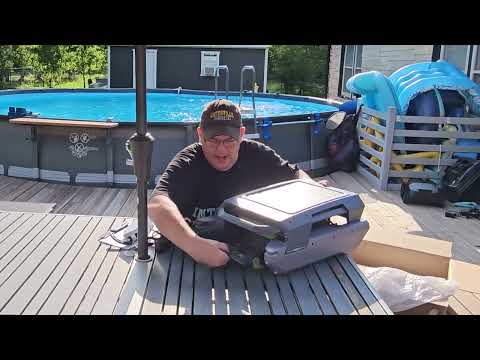
Basket access is a meaningful maintenance advantage
Maintenance can make or break a pool gadget. A device may collect debris successfully, but if emptying it involves awkward clips, tools, or a frustrating sequence, it simply trades one chore for another. The P1’s basket arrangement was one of the clearer positives in my handling.
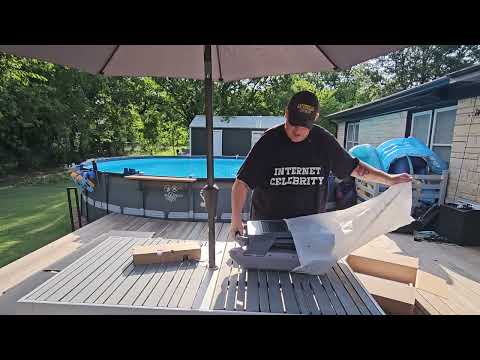
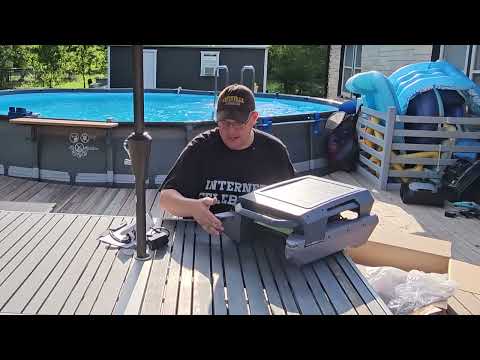
I pulled the basket assembly out, removed the debris basket, and slid it back into place. There was no complicated latch sequence or special tool involved. That is the kind of straightforward interaction I want from a product intended to catch leaves and bugs on a regular basis.
It also helps set reasonable expectations for basket care. This is a surface-debris skimmer, not a giant storage bin. During leaf season, after wind, or whenever there is a heavier-than-normal amount of material on the water, regular emptying will still be part of owning it. The benefit is not that maintenance disappears; it is that the collection and emptying process appears uncomplicated.
I did not measure basket capacity or compare how often it needs emptying under different debris loads. Buyers with lots of large leaves should consider that an open question and plan for more frequent checks than a pool that only sees occasional bugs or small floating material.
Manufacturer claims versus what I handled
Anpool markets the P1 as a dual-energy robotic pool skimmer with solar and DC charging. The solar-triggered fan activation, rear charging port, and included charging accessory all align with that basic design. The company also advertises Smart Path Planning, obstacle avoidance, auto parking, stairway prevention, automatic power renewal, and Smart Path Planning and Random Cleaning modes.
Anpool further says a full DC charge can provide up to five hours of operation, with sunlight extending operation up to 10 hours. Those are manufacturer claims, not numbers I measured. I also did not test recharge time, pool-size compatibility, debris capacity, water-type compatibility, long-term durability, or the extent to which solar power sustains cleaning during a real pool session.
That does not make the P1’s observed hardware less useful. It means the evidence is strongest around the things I directly handled: the included charger and hook, the physical switch, the rear fans activating in sunlight, the smooth front rollers, the visible intake, and the removable basket. Buyers should weigh those tangible usability details alongside their own need for runtime and navigation certainty.
+ Pros
- Solar exposure activated the rear fans during my handling.
- Includes a backup wall-charging accessory.
- Pole hook gives you a simple retrieval option.
- Front rollers felt smooth and are intended to travel along pool walls.
- Debris basket was easy to remove and slide back in.
- The intake mechanism stopped when it contacted my hand.
! What to know
- This is a surface-debris skimmer, not a floor vacuum or wall-cleaning robot.
- Anpool's advertised runtime, navigation, and automatic features were not measured in my hands-on use.
- The unit should be fully charged before first use according to its on-unit instruction.
Who should consider the Anpool P1
I would consider this solar pool skimmer if the top of the water is your recurring cleanup problem and you want to reduce how often you use a hand skimmer. It is especially relevant for someone who values solar assistance but wants the reassurance of a backup wall-charging option. That combination is more flexible than a purely solar device when weather or pool placement is less than ideal.
The P1 also makes sense for a buyer who values easy everyday handling. The basket was simple to remove and reinstall, the on/off switch is clear, and the pole hook offers a practical retrieval method. Those are not luxury features; they are the details that make a device less annoying to own.
I would not choose it expecting it to vacuum the floor, scrub walls, replace water circulation, or eliminate all manual pool maintenance. It is built around floating debris. If the mess in your pool is mostly at the bottom, a floor-oriented robotic cleaner or vacuum is the more appropriate category. If surface debris is the main issue, the P1’s focused design is the point.
Buying questions to answer before ordering
First, identify where your debris actually lives. A surface skimmer is a much better match when leaves and bugs remain on top than when dirt and debris consistently sink. Second, think about sun exposure. I confirmed that sunlight activated the rear fans, but I did not establish sustained solar runtime in different weather or shade conditions. A pool surrounded by trees, structures, or heavy shade makes the included charging accessory more important.
Third, consider your pool layout and expectations for autonomous travel. The rollers and front sensors are intended to help with walls and obstacles, but I did not test behavior around steps, unusual curves, ledges, or every obstacle type. If flawless navigation in a complicated pool is your deciding requirement, look for current product documentation and return terms that fit that concern.
Finally, consider the routine after collection. You will need to retrieve the skimmer and empty its basket. The hook and simple slide-out basket make those jobs look manageable, but the frequency will depend on what falls into your pool. Buyers looking for a low-effort surface-maintenance helper should find the P1’s handling details encouraging; buyers expecting a complete pool-cleaning system should choose a different tool.
Specs
| Spec | Detail |
|---|---|
| Product | Anpool P1 Solar-Powered Robotic Pool Skimmer |
| Power design | Solar-powered with DC charging support claimed by Anpool |
| Charging indicator | Red while charging; turns off when charging is complete |
| Basket | Removable, slide-in debris basket |
| Front hardware | Smooth roller wheels and front sensors |
| Included items observed | Skimmer, manual, charging accessory, and pool-pole hook |
Scorecard
Clear switch, simple basket removal, and a retrieval hook.
Solar activation plus a backup wall-charging accessory.
The basket pulled out and slid back in easily.
Front intake, rollers, and sensors are purpose-built for floating debris.
Runtime and automated navigation figures come from Anpool, not my measurements.
Frequently asked questions
Does the Anpool P1 run only on solar power?
No. The P1 has a solar-powered design, but I also found a charging port and a backup charging accessory in the box. Anpool describes it as a dual-energy design with solar and DC charging. The on-unit instruction says to fully charge the device before its first use.
How do you retrieve the Anpool P1 from the pool?
A hook attachment is included for connecting to a pool pole. That gives you a way to pull the skimmer toward you without leaning into the water or waiting for it to drift close to the pool edge.
Is the debris basket easy to remove?
Yes. I pulled the basket assembly out and slid it back into place without a complicated process or tools. That does not establish basket capacity, but the access and reinstall process were straightforward in my handling.
What does this robotic pool skimmer clean?
It is intended for floating surface debris, including leaves, bugs, and similar material on top of pool water. It is not a substitute for a bottom vacuum, wall-cleaning robot, pool filter, or the rest of normal pool maintenance.
How long does the Anpool P1 run?
Anpool claims up to five hours after a full DC charge and up to 10 hours when sunlight extends operation. Actual runtime will depend on conditions, and I did not measure runtime, recharge time, or solar-sustained cleaning time myself.
Does the Anpool P1 avoid walls and obstacles?
The P1 has front sensors intended to help with obstacle avoidance, and its smooth front rollers are designed to roll along a pool wall after contact. Anpool also advertises navigation features, but I did not test its real-world path behavior, stairway handling, or parking in a pool.
Final recommendation
The Anpool P1 has the right practical ingredients for a surface skimmer: visible solar activation, a backup charging route, smooth front rollers, a removable basket, and a pole hook for retrieval. None of that is flashy, but it is useful. For a product intended to reduce a repetitive surface-cleaning chore, simple handling matters.
I would buy it for cordless help with floating debris if I were comfortable treating the advertised runtime and automated navigation features as manufacturer claims rather than my measured results. The hardware and maintenance details I checked were sensible and easy to understand. Just match it to the correct job: keeping the top of the pool cleaner, not replacing every other cleaning tool you own.
As an Amazon Associate I earn from qualifying purchases.