Lighted Christmas Village Post Office: Is It Worth It?
This compact ceramic post office brings solid construction, small interior details, and a warm village glow to a holiday display.
Affiliate disclosure: As an Amazon Associate I earn from qualifying purchases. This article may contain affiliate links, which means I may earn a commission at no extra cost to you.
If you are trying to choose one building that gives a small holiday setup some identity, this lighted Christmas village post office is a compelling option. I handled the MUMTOP ceramic post office, switched on its light, looked through its windows, and considered the shelf space it needs. It has the sort of recognizable town-building character that a generic village house does not automatically bring. More importantly, it feels substantial in hand, has a padded underside for furniture, and uses illumination to make details inside the building easier to enjoy.
This is not a tiny accessory meant to disappear in a crowded display. It can work alone as the building that starts a small Christmas village, or it can join other matching units when the goal is a fuller miniature town. Before choosing it, measure your available depth: the main decision is whether your shelf, mantel, tabletop, or bookcase can accommodate a piece that needs about 5 1/2 inches from front to back.
A strong pick for Christmas-village collectors who want a compact illuminated landmark. The solid ceramic feel, padded base, interior details, and removable light make it more versatile than a basic decorative building.
As an Amazon Associate I earn from qualifying purchases.
Why this lighted Christmas village post office earns attention
The first thing I noticed was the physical feel. This is ceramic, and it has good weight to it. In hand, it feels like a nice, solid unit rather than a lightweight decorative shell. That does not establish anything about years of use, but it matters for a seasonal piece that will be set out, moved into place, and packed away as part of an annual decorating routine. A building with some substance is more reassuring to handle than one that feels insubstantial.
I also appreciated a detail that is easy to miss when shopping from a product photo: there is padding on the bottom. The building is not simply resting bare ceramic against the table or shelf. That padding is intended to keep it from scratching the display surface, which is useful whether the village is going on finished wood, a bookcase, a tabletop, or a mantel. It is a modest feature, but it solves a practical concern without requiring a separate protective pad underneath the building.
The post-office theme helps, too. A post office reads immediately as a town landmark. In a small display, that gives the arrangement a destination and a little sense of purpose. Rather than relying on size alone to become noticeable, this building has a distinct role in the scene. It can make a village feel more like a town even when there are only a few pieces on the surface.
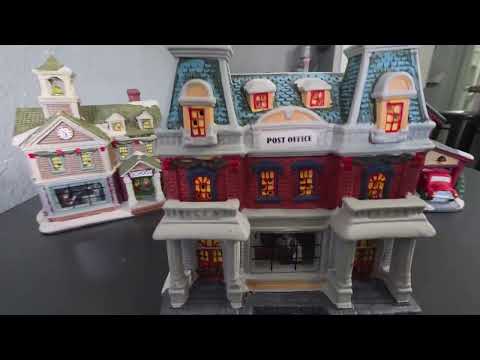
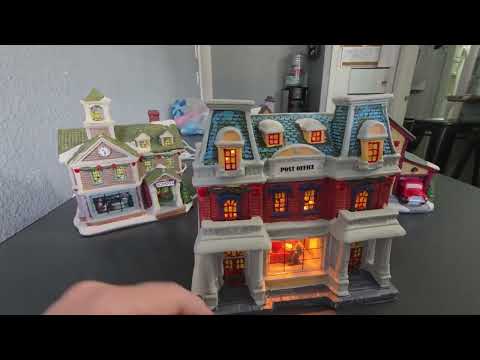
There are details across the exterior, including the mailboxes and windows, so the building has interest before the light is involved. Still, the lighting is what changes it from a solid decorative object into a more convincing occupied-looking miniature. Once illuminated, the windows, upper portion, and side openings all become part of the effect.
| Type | Lighted ceramic Christmas village post office |
|---|---|
| Display footprint | Allow about 9 in. W x 5 1/2 in. D |
| Lighting | Integrated removable light |
| Surface protection | Padded base |
| Best use | Standalone focal point or fuller village town |
The light makes the miniature scene easier to enjoy
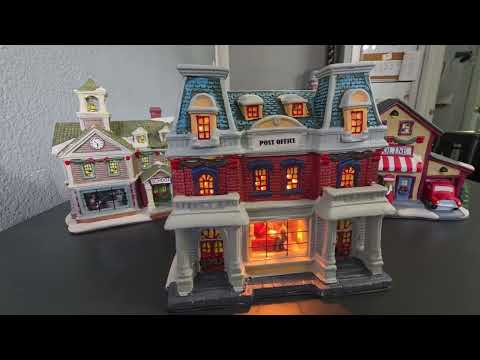
I turned on the switch and could see the interior illumination coming through several openings. The effect is not limited to a single front-facing window. Light reaches the windows, the upper area, and the side, which gives the post office more visual presence from more than one viewing position. That is valuable on a tabletop or mantel where someone may see the village from an angle rather than straight on.
The interior is where the light pays off most clearly. Through a window, I could see two small figures inside. Those figures are easy to overlook when the building is unlit, but the illumination makes the small scene more apparent. The mailboxes and post-office details behind them contribute to the story. Instead of a building that is merely shaped like a post office, this one contains visual details that support the theme.
That distinction matters for a compact display. When a village only has room for a few buildings, each piece needs to do some work visually. Here, the exterior provides the town-building silhouette, while the lighting draws attention to details that would otherwise be less noticeable. The result is layered interest without needing to add a large footprint or extra loose accessories around it.
I would especially consider the lighting if the display is intended for evening viewing. The light is visible through the different openings, and the interior scene becomes easier to spot once it is on. I did not test brightness in a dark room, identify the light type, or establish a power source or runtime, so I cannot offer guidance on those points. What I can say from handling this piece is that the lit presentation is central to why its small details stand out.
There is also a useful choice built into the design: the light can be removed. If an unlit arrangement better fits the rest of your village, the ceramic post office can remain in the display without the illuminated effect. That is practical flexibility for decorators who sometimes want a daytime-style setup or who prefer to decide which buildings are lit rather than treating every piece as permanently illuminated.
How much space does the post office need?
For this kind of decor, depth is often the measurement that decides the purchase. A building can look compact in a listing, yet still project too far over the front of a narrow ledge. My practical placement guidance is to allow just under 9 inches of width and about 5 1/2 inches of depth. For vertical room, roughly 7 1/2 to 8 inches should be enough clearance in the placement I considered.
Those are working display estimates, not precise catalog specifications. The current retailer listing gives dimensions of 5.31 inches deep, 7.8 inches wide, and 8.7 inches high. Since my handling-based guidance and the retailer figures differ a little, I would not build a tightly fitted display around either number alone. Give the piece some breathing room, especially if it will sit under a bookcase shelf, near other village structures, or alongside garland and other holiday decor.
The practical takeaway is straightforward. If your shelf is shallower than about 5 1/2 inches, pause before ordering. The building may be a poor fit even if the width seems manageable. If you have enough depth, the compact tabletop format makes it a reasonable candidate for a mantel, shelf, bookcase, or table. It has enough presence to be a main building in a small arrangement rather than only a filler piece.
Placement also changes how much of the detail you see. A spot where the front windows are visible is the obvious starting point, since that is where the interior figures can be noticed. But the side illumination means it does not need to be treated as a strictly front-view-only object. In a more open arrangement, the light coming from the side helps it retain some interest as people move around the display.
Building a small town around one landmark
I think this post office is most useful for shoppers who want their display to feel intentional without collecting a huge number of miniatures. It works by itself as a Christmas-village piece, which makes sense for a tabletop with only one focal object or a small seasonal corner on a shelf. The combination of ceramic construction, windows, mailboxes, and lit interior gives it enough character to carry that assignment.
It also makes sense as part of a growing town. Pair it with other village units and the post office adds a recognizable civic or commercial-style building among the houses. That changes the visual balance of a collection. A group made entirely of house-shaped pieces can feel repetitive; a post office gives the town another function and helps the scene read as a place rather than a row of buildings.
I would not assume it will match every other Christmas-village line perfectly. I did not establish cross-brand scale, color, or style compatibility. If you are extending an existing collection from another brand, compare your own pieces and available space carefully. The safer recommendation is based on what I handled: it has the visual weight and enough standalone detail to work alone, and it can be paired with other units to create a fuller-town look.
For a small display, I would keep the surrounding arrangement simple enough that the windows and post-office features remain visible. The appeal here is not just the outline of the building. It is the fact that light helps reveal the miniature scene and reaches multiple openings. Crowding every side with taller decorations could reduce the reason to choose this particular building in the first place.
Who will get the most from this village building?
- Christmas-village collectors: This is a recognizable landmark for anyone who wants a post office rather than another generic house-shaped building.
- Small-space holiday decorators: It has a manageable tabletop format for a shelf, mantel, bookcase, or table, provided you first confirm the depth.
- Shoppers starting a village: The building has enough detail and illuminated presence to make sense on its own instead of requiring an immediate collection of many pieces.
- People expanding a town display: It can sit alongside other village units and add a different building type to the scene.
- Decorators who want lighting options: The removable light means the piece can be used illuminated or unlit.
The less suitable shopper is someone with an extremely narrow ledge or someone who needs an exact match to a particular established village line. Depth is the concrete limitation I encountered, while brand-to-brand scale and styling were not established. This is best approached as an indoor tabletop, mantel, shelf, or bookcase decoration with enough room around it to be seen.
What stood out during hands-on use
The most persuasive part of this piece is how several modest features work together. The solid feel gives the ceramic building a more substantial presence. The padded bottom adds consideration for the furniture beneath it. The exterior mailboxes and windows establish the post-office theme. Then the interior figures and illumination give the piece another layer when the light is switched on.
None of those details needs to be overcomplicated to be useful. The post office does not need a long feature list to earn a spot in a holiday display. It needs to look good where it sits, avoid creating an unnecessary concern for the surface underneath, and offer something worth looking at when the village lights come on. In my hands, it delivered on those core display priorities.
The removable light is also more meaningful than it initially sounds. Some decorators want every building lit, while others prefer to control the number of illuminated elements in a scene. Being able to remove the light lets the post office remain useful in either approach. It is a small decision point, but it makes the product more adaptable than a building that must always be presented in one mode.
+ Pros
- Solid, substantial-feeling ceramic construction
- Padded bottom helps protect tables and shelves
- Integrated lighting reveals interior details and shines through several openings
- Two visible interior figures, mailboxes, and exterior details add character
- Removable light allows an illuminated or unlit display
- Compact enough for many tabletop, mantel, shelf, and bookcase setups
! What to know
- Plan for about 5 1/2 inches of shelf depth; it may be too deep for very narrow ledges.
- Hands-on display-space measurements are practical estimates, while the retailer lists slightly different exact dimensions.
- The retailer markets it for indoor tabletop, mantel, or shelf display.
Specifications, listing details, and buying context
The retailer identifies this as model 5202010 and lists ceramic as the material. Its listed dimensions are 5.31 inches deep by 7.8 inches wide by 8.7 inches high. Treat those as retailer-listed specifications. My own size guidance is based on practical placement: just under 9 inches wide, around 5 1/2 inches deep, and approximately 7 1/2 to 8 inches of clearance in height.
That difference is not a reason to dismiss either set of numbers. It is a reason to measure your display area with a little extra margin. A shelf opening that is exactly 8 inches tall, for example, does not leave much room if you are relying on the retailer-listed 8.7-inch height. Likewise, a narrow ledge that is only around 5 inches deep is not where I would plan to place this building.
The listing markets the post office for indoor tabletop, mantel, or shelf display. That aligns with the format I handled: it is a ceramic village building sized for a household display surface, not a large floor decoration. I did not test long-term durability of the ceramic body, the switch, or the removable light, so those remain open questions rather than factors in my hands-on assessment.
Specs
| Spec | Detail |
|---|---|
| Product | MUMTOP Christmas Village Post Office, Lighted Ceramic Christmas Village |
| Model number | 5202010 (retailer listed) |
| Material | Ceramic (retailer listed) |
| Listed dimensions | 5.31 in. D x 7.8 in. W x 8.7 in. H |
| Practical placement guidance | Just under 9 in. W x about 5 1/2 in. D x roughly 7 1/2–8 in. H |
| Light feature | Integrated light is removable |
| Base | Padded to help protect display surfaces |
My recommendation for Christmas village shoppers
I would recommend this lighted Christmas village post office to someone who wants one compact landmark that offers more than a simple lit facade. The solid ceramic feel, protective padded base, visible mailboxes, two interior figures, and light coming through several openings give it a finished look. It is particularly appealing when every building in a small village needs to contribute some personality.
Measure first, especially for depth and vertical clearance. Once you know the building has room, the choice comes down to your display style. Use it as a standalone post office to anchor a small scene, or place it with other village units to make the town feel more complete. If you like the look of an illuminated miniature scene but want the option to go unlit later, the removable light is a genuine advantage.
For the right shelf or tabletop, this is not merely a seasonal building that occupies space. It is a post office with enough physical presence and small visual rewards to help a Christmas village look more intentional.
Scorecard
Solid-feeling ceramic body with a padded base.
Mailboxes, windows, and a visible miniature interior add interest.
Light reaches several openings and reveals more of the scene.
Works alone or with other buildings; light can be removed.
Compact, but the 5 1/2-inch depth needs checking first.
As an Amazon Associate I earn from qualifying purchases.